PRÓXIMOS LANÇAMENTOS
Acompanhe os próximos lançamentos espaciais programados. Fique por dentro das missões que estão prestes a decolar e expandir nosso conhecimento do cosmos.
Carregando lançamentos...
Acompanhe os próximos lançamentos espaciais programados. Fique por dentro das missões que estão prestes a decolar e expandir nosso conhecimento do cosmos.
Carregando lançamentos...

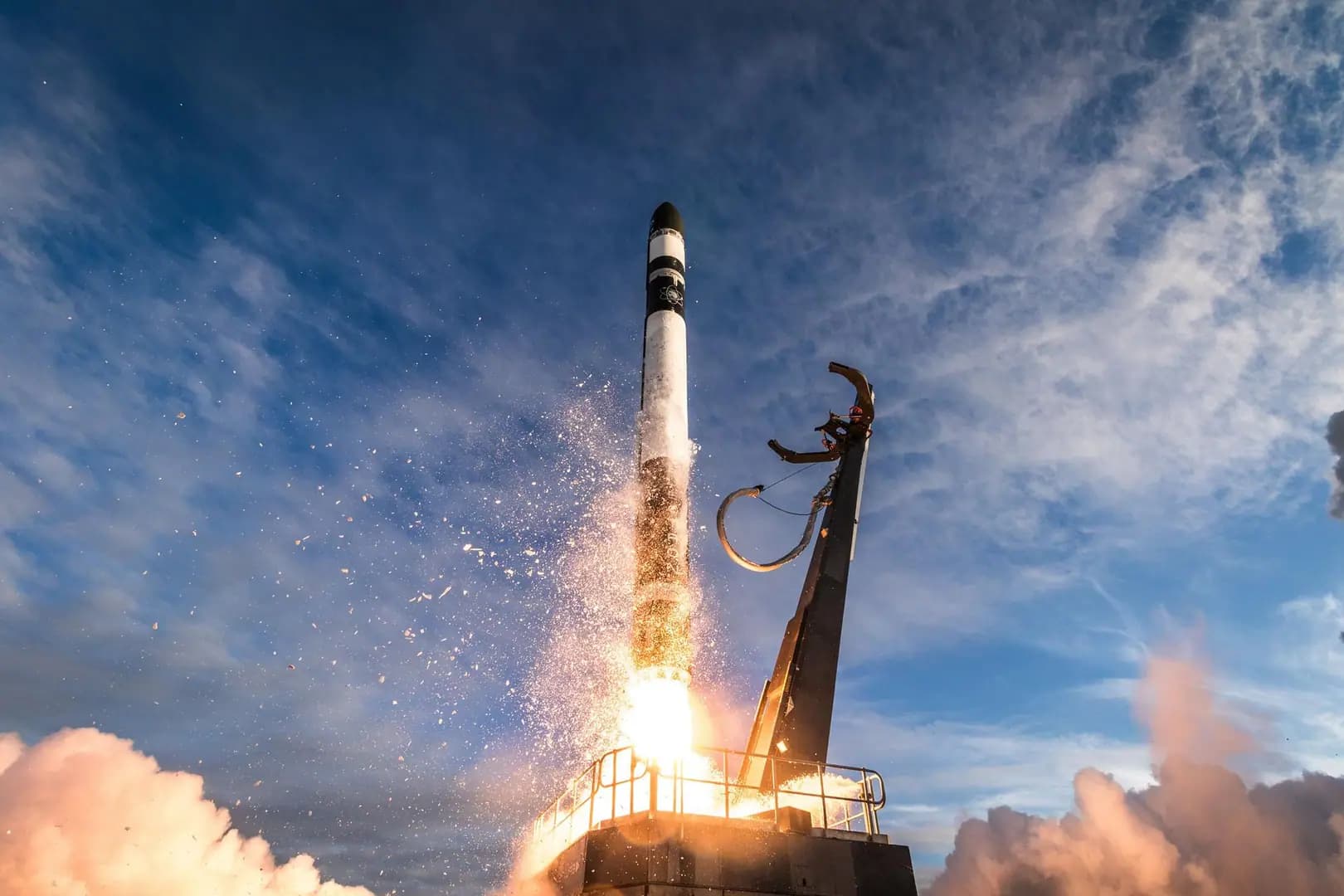
RAISE-4 is a Japanese technology-demo satellite launched under JAXA’s Innovative Satellite Technology Demonstration Program, flying aboard a dedicated mission from Rocket Lab out of New Zealand. The single small satellite will carry eight experimental technologies from Japanese industry and academia, with the goal of validating new on-orbit capabilities such as onboard processing, advanced sensors, propulsion systems, and autonomous operations. Among the payloads aboard RAISE-4 is a deployable sail system (D-SAIL) that increases atmospheric drag to accelerate de-orbiting, as well as a commercial-grade GPU module for edge-computing in orbit, and an electric propulsion experiment. Together these systems support Japan’s push to enhance its small-satellite ecosystem, deepen commercial partnerships, and leverage dedicated small-launch access for flexible space missions.

Sem descrição disponível

Sem descrição disponível
First launch of the Ceres-2, an upgraded version of the Ceres-1 with increased payload capacity.

Atlas V will launch the 7th set of Amazon Leo satellites. This is the fourth Leo launch on an Atlas V, and the first launch to use the new abbreviation "L" for Leo on its name, instead of "K" for the former name "Project Kuiper".

Elektro-L is an advanced Russian heavy meteorological satellite. Its mission will help in weather forecasting, studying seas and oceans, navigating aircraft and ships, as well as researching the ionosphere and magnetic fields.

Sem descrição disponível

Launch vehicle also unconfirmed.

Sem descrição disponível

The QZSS is a Japanese satellite navigation system that augments the U.S. GPS in the Asia-Pacific region. QZS-5 will be launched on H3 flight no. 8.

First launch of the Long March 12A, which is the partially reusable variant of the Long March 12. The booster will attempt a landing at a pad roughly 300km downrange of Jiuquan Satellite Launch Center.

This is Galileo Launch 14 (L14) and the first launch of Galileo satellites on an Ariane 6 rocket. The satellites to be placed in orbit are designated SAT 33 and SAT 34, and still belong to the first generation of Galileo satellites. Four more satellites of this generation are still to be deployed, after which second generation Galileo satellites will begin to replace the first generation. Galileo is presently the world’s most precise satellite navigation system. It serves over five billion smartphone users.

First orbital launch attempt from Brazilian territory in 22 years, it is also the first commercial orbital launch from the Alcântara Launch Center in the Brazilian state of Maranhão. This launch will carry 5 satellites and 3 experiments to low Earth orbit. The Hanbit-Nano two stage rocket is being developed by the South Korean startup Innospace.

Multipurpose X-band radar earth observation satellite, launching alongside an unconfirmed complement of secondary payloads.

The STP-S30 mission is a U.S. Space Force initiative aimed at deploying research experiments and technology demonstrations to orbit, contributing to the development of future space systems. The primary payload for this mission is DISKSat, a unique, disk-shaped satellite approximately 1 meter in diameter. DISKSat is designed to operate in very low Earth orbit (VLEO) and will test technologies intended to enhance on-orbit persistence.

Block 2 BlueBirds will deliver up to 10 times the bandwidth capacity of the BlueBird satellites in orbit today. Featuring up to 2,400 square foot communications arrays, they will be the largest ever satellites commercially deployed in low Earth orbit.

Sem descrição disponível

Soyuz-5, also known as Irtysh, is the new generation medium-class launch vehicle developed by Russia in cooperation with Kazakhstan to replace the Zenit-2 and Proton Medium launch vehicles, and to keep Baikonur cosmodrome operational while Vostochny cosmodrome takes on the role of the main Russian spaceport. It was previously known as project Sunkar/Fenix. The first stage of this launch vehicle will be used in the planned super-heavy Yenisey rocket, capable of lifting 100 tons of payload to low Earth orbit, and is considered the first stage in achieving this goal. Live firing tests of the fully intergrated first stage of Soyuz-5 were completed in March 2025. It is currently unclear whether the test flight will carry a mass simulator or a functional payload.

This is a rideshare mission. The primary satellite, EOS-N1 (codenamed Anvesha), is a hyperspectral imaging satellite developed largely for the DRDO (Defence Research and Development Organisation). It is capable of "seeing" in hundreds of wavelengths to identify materials on the ground—making it a high-priority asset for national security and surveillance. The PSLV-C62 rocket is carrying roughly up to 18 secondary payloads, including KID (Kestrel Initial Demonstrator), which is a small re-entry capsule from a European/Spanish startup (Orbital Paradigm) attempting a survivable atmospheric re-entry and various CubeSats from Indian startups and universities.

Sem descrição disponível

A constellation of two Earth observation satellites able to deliver stereoscopic imaging that allows for the creation of 3D models. Additional payload will include: Aist-ST, Vladivostok-2, Grifon 1-4, Zorkiy-2M №3, Zorkiy-2M №5, Zorkiy-2M №7, Leonov (FGTU-1, MGOTU-1), Lobachevskiy, Marafon №1, Marafon №2, ODR-1 E.T. Krenkel (ODRSat-1 KRENKEL), SamSat-ORION (SamSat-ORION, SamSat-Mayak), Skorpion (under program MGU "Sozvezdiye-270"), Khors №5, Yarilo №5, ANSAT-1, Polytech Universe-6 (Politekh Yunivers-6), SCH-619, 20x SITRO-AIS, SM-3.1, TELUM-LEO-1E 1, TELUM-LEO-1E 2, Toloo-3 (Tolu-3), VM-3.1 (Voyenmekh), and foreign payloads: Luča (Montenegro), QMR-KWT-2 (Kuwait), Kowsar-1.5 (Iran), Paya (Iran), Zafar-2 (Iran), NASBSAT-1 (Belarus), NASBSAT-2 (Belarus).

Sem descrição disponível

Launch vehicle also unconfirmed

Russian navigation satellite for dual purposes: civilian and military

Sem descrição disponível