APOD
Astronomy Picture of the Day
Discover the cosmos! Each day a different image or photograph of our fascinating universe is featured, along with a brief explanation written by a professional astronomer.


SN Encore: A Second Supernova Seen Several Times
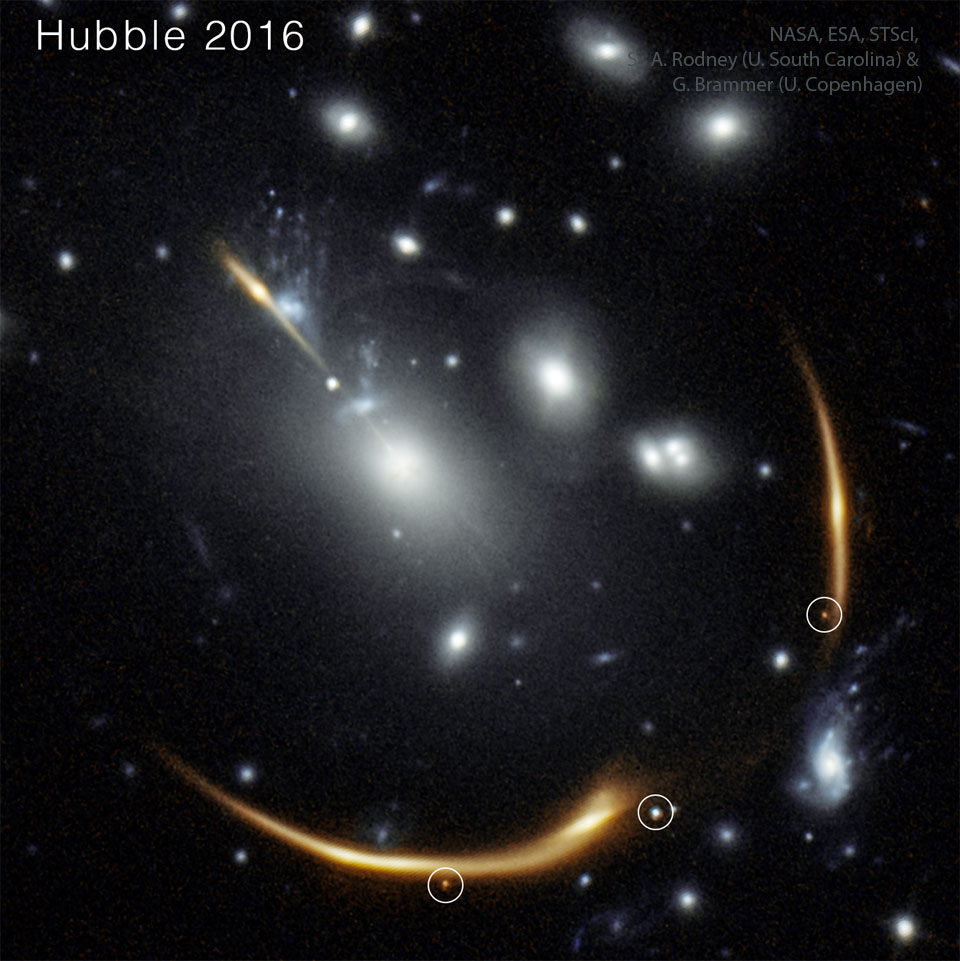
Explanation: Now a second supernova in this same galaxy is repeating. The cause is the gravitational lens effect of a massive foreground cluster of galaxies (MACS J0138) -- it creates multiple images of a perfectly aligned background galaxy (MRG-M0138). What's particularly interesting is that this background galaxy has young stars that keep blowing up. And images of each supernova explosion keep coming to us multiple times through different paths through the cluster. The original lensed supernova set, shown in the rollover , is called Requiem and was first seen by the Hubble Space Telescope in 2016. This second lensed supernova set is called Encore and was first seen by the Webb Space Telescope in 2023. More images from these supernovas are predicted to be on the way , and exactly when they arrive should help humanity to better understand the mass distribution of the galaxy cluster, the supernovas themselves, and possibly even the universe .
| Date | October 7, 2025 |
|---|---|
| Credit |
Images Credit: Webb (main): NASA , ESA , CSA , STScI , J. Pierel ( STScI ) & A. Newman ( Carnegie Inst. for Science ); Hubble (rollover): NASA , ESA , STScI , S. A. Rodney ( U. South Carolina ) & G. Brammer ( NBI, U. Copenhagen ) |
| Authors & editors: | Robert Nemiroff (MTU) & Jerry Bonnell (UMCP) |
| A service of: |
ASD at NASA / GSFC, NASA Science Activation & Michigan Tech. U. |