APOD
Astronomy Picture of the Day
Discover the cosmos! Each day a different image or photograph of our fascinating universe is featured, along with a brief explanation written by a professional astronomer.
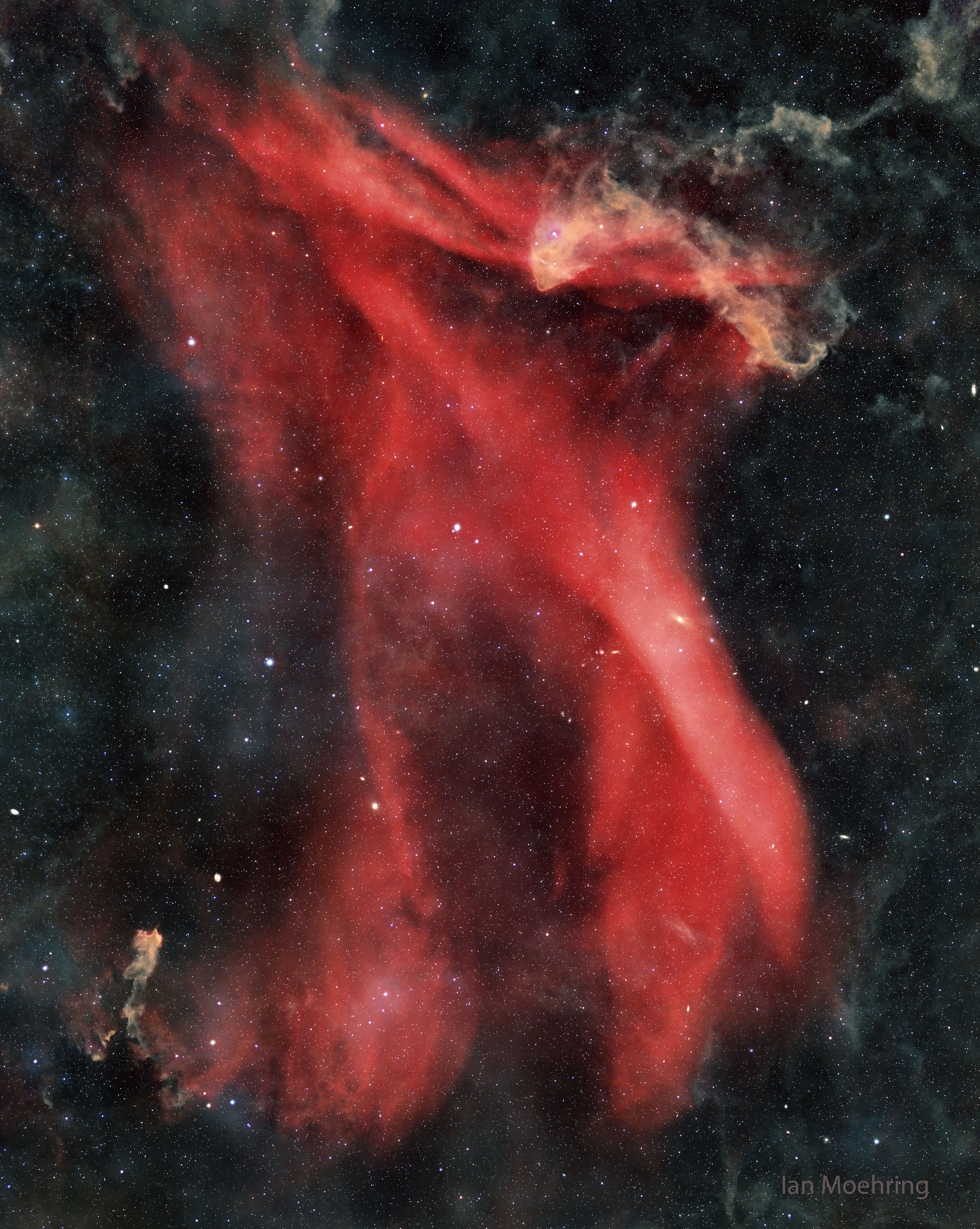
The Great Lacerta Nebula
Explanation: It is one of the largest nebulas on the sky -- why isn't it better known? Roughly the same angular size as the Andromeda Galaxy , the Great Lacerta Nebula can be found toward the constellation of the Lizard (Lacerta) . The emission nebula is difficult to see with wide-field binoculars because it is so faint , but also usually difficult to see with a large telescope because it is so great in angle -- spanning about three degrees . The depth, breadth, waves , and beauty of the nebula -- cataloged as Sharpless 126 (Sh2-126) -- can best be seen and appreciated with a long duration camera exposure . The featured image is one such combined exposure -- in this case taken over three nights in August through dark skies in Moses Lake , Washington , USA . The hydrogen gas in the Great Lacerta Nebula glows red because it is excited by light from the bright star 10 Lacertae , one of the bright blue stars just to the left of the red-glowing nebula's center. Most of the stars and nebula are about 1,200 light years distant.
Jigsaw Universe: Astronomy Puzzle of the Day
| Date | September 10, 2025 |
|---|---|
| Credit | Image Credit & Copyright: Ian Moehring & Kevin Roylance |
| Authors & editors: | Robert Nemiroff (MTU) & Jerry Bonnell (UMCP) |
| A service of: |
ASD at NASA / GSFC, NASA Science Activation & Michigan Tech. U. |