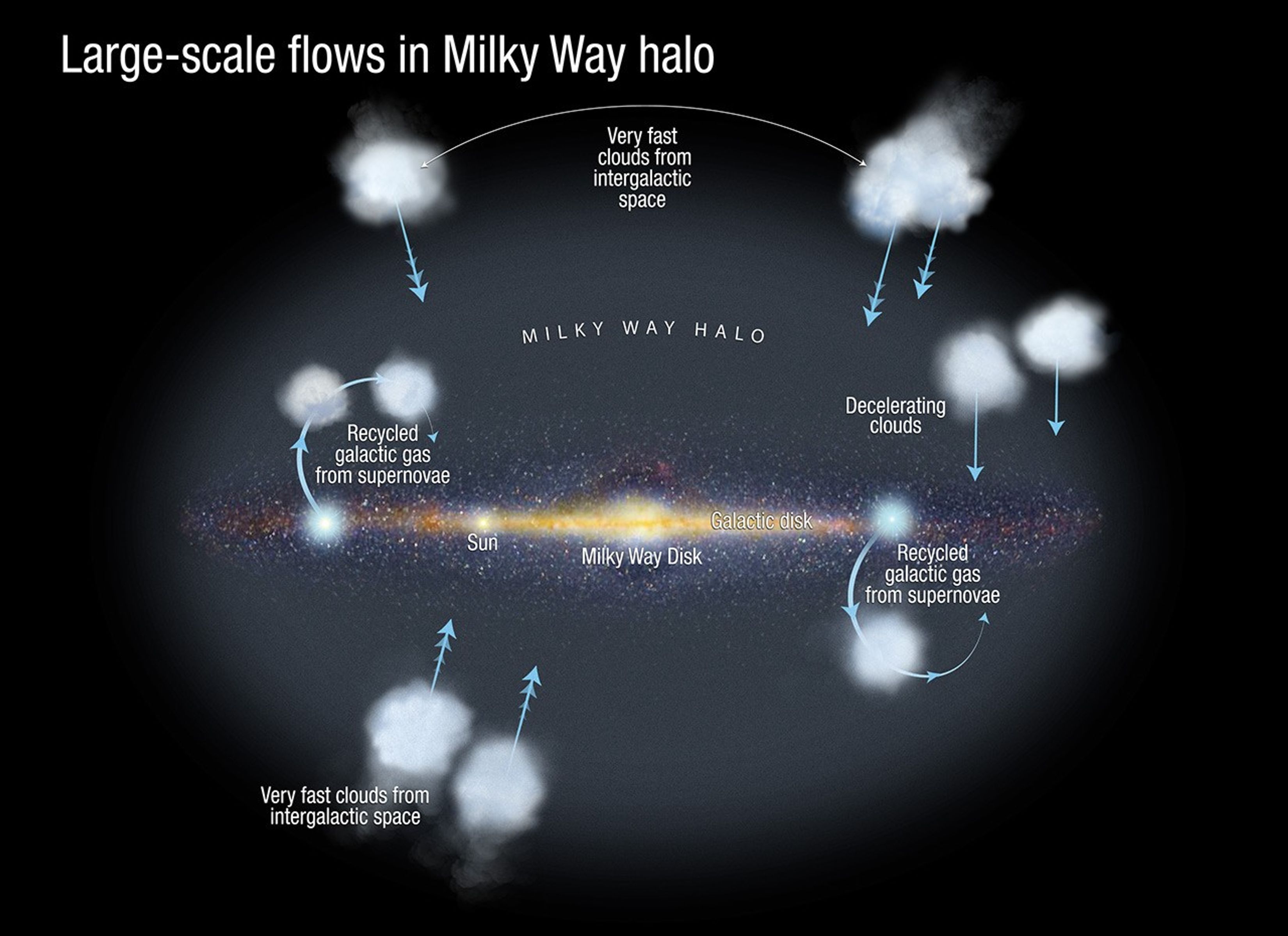
This diagram shows the large-scale flows of gas in the Milky Way halo of faint stars and hot gas. Using the Hubble Space Telescope's Cosmic Origins Spectrograph and Space Telescope Imaging Spectrograph, Nicolas Lehner and Chris Howk at the University of Notre Dame were able to...
The long-term forecast for the Milky Way is cloudy with gaseous rain. A study by Nicolas Lehner and Christopher Howk of the University of Notre Dame concludes that massive clouds of ionized gas are raining down from our galaxy's halo and intergalactic space and will continue to provide fuel for the Milky Way to keep forming stars. Using the Hubble Space Telescope's Cosmic Origins Spectrograph they measured for the first time the distances to huge, fast-moving clouds of ionized gas previously seen covering a large fraction of the sky.