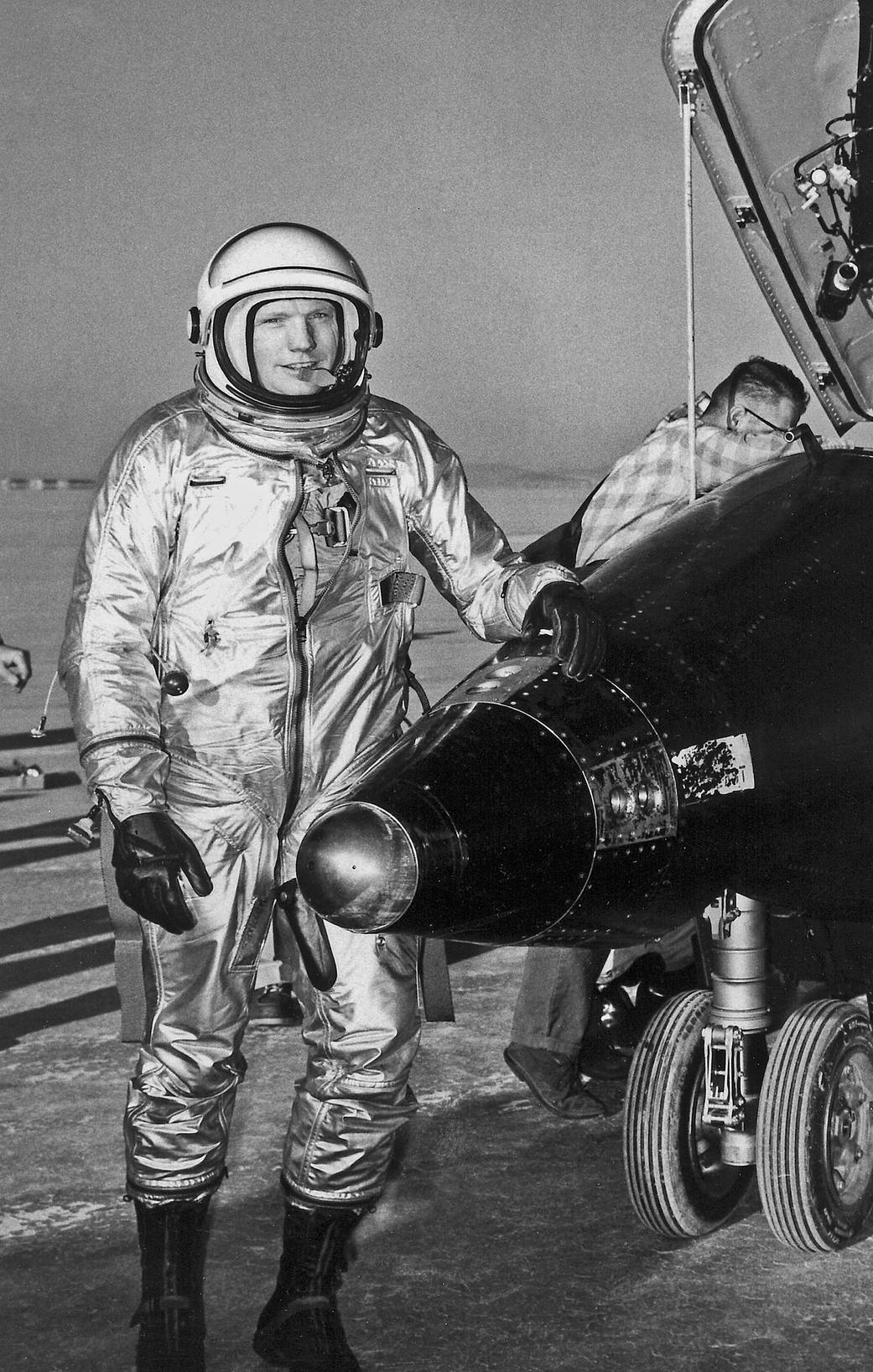
E-USAF-Armstrong-X-15
NASA test pilot Neil Armstrong is seen here next to the X-15 ship #1 (56-6670) after a research flight. Neil A. Armstrong joined the National Advisory Committee for Aeronautics (NACA) at the Lewis Flight Propulsion Laboratory (later NASA’s Lewis Research Center, Cleveland, OH, and today the Glenn Research Center) in 1955. Later that year, he transferred to the NACA’s High-Speed Flight Station (today, NASA’s Dryden Flight Research Center) in Edwards, CA, as an aeronautical research scientist and then as a pilot, a position he held until becoming an astronaut in 1962. He was one of nine NASA astronauts in the second class to be chosen.
Armstrong was actively engaged in both piloting and engineering aspects of the X-15 program from its inception. He completed the first flight in the aircraft equipped with a new flow-direction sensor (ball nose) and the initial flight in an X-15 equipped with a self-adaptive flight control system. He worked closely with designers and engineers in development of the adaptive system, and made seven flights in the rocket plane from December 1960 until July 1962. During those fights he reached a peak altitude of 207,500 feet in the X-15-3, and a speed of 3,989 mph (Mach 5.74) in the X-15-1.
Armstrong attended Purdue University, earning his Bachelor of Science degree in aeronautical engineering in 1955. During the Korean War, which interrupted his engineering studies, he flew 78 combat missions in F9F-2 jet fighters. He was awarded the Air Medal and two Gold Stars. He later earned a Master of Science degree in aerospace engineering from the University of Southern California.
Armstrong has a total of 8 days and 14 hours in space, including 2 hours and 48 minutes walking on the Moon. In March 1966 he was commander of the Gemini 8 orbital space flight with David Scott as pilot-the first successful docking of two vehicles in orbit. On July 20, 1969, during the Apollo 11 lunar mission, he became the first human to set foot on the Moon. From 1969 to 1971 he was Deputy Associate Administrator for Aeronautics at NASA Headquarters, and resigned from NASA in August 1971 to become Professor of Engineering at the University of Cincinnati, a post he held until 1979. He became Chairman of the Board of Cardwell International, Ltd., in Lebanon, OH, in 1980 and served in that capacity until 1982. During the years 1982-1992, Armstrong was chairman of Computing Technologies for Aviation, Inc., in Charlottesville, VA. From 1981 to 1999, he served on the board of directors for Eaton Corp.1960sNASA Photo / USAF Photo› X-15 Project Description