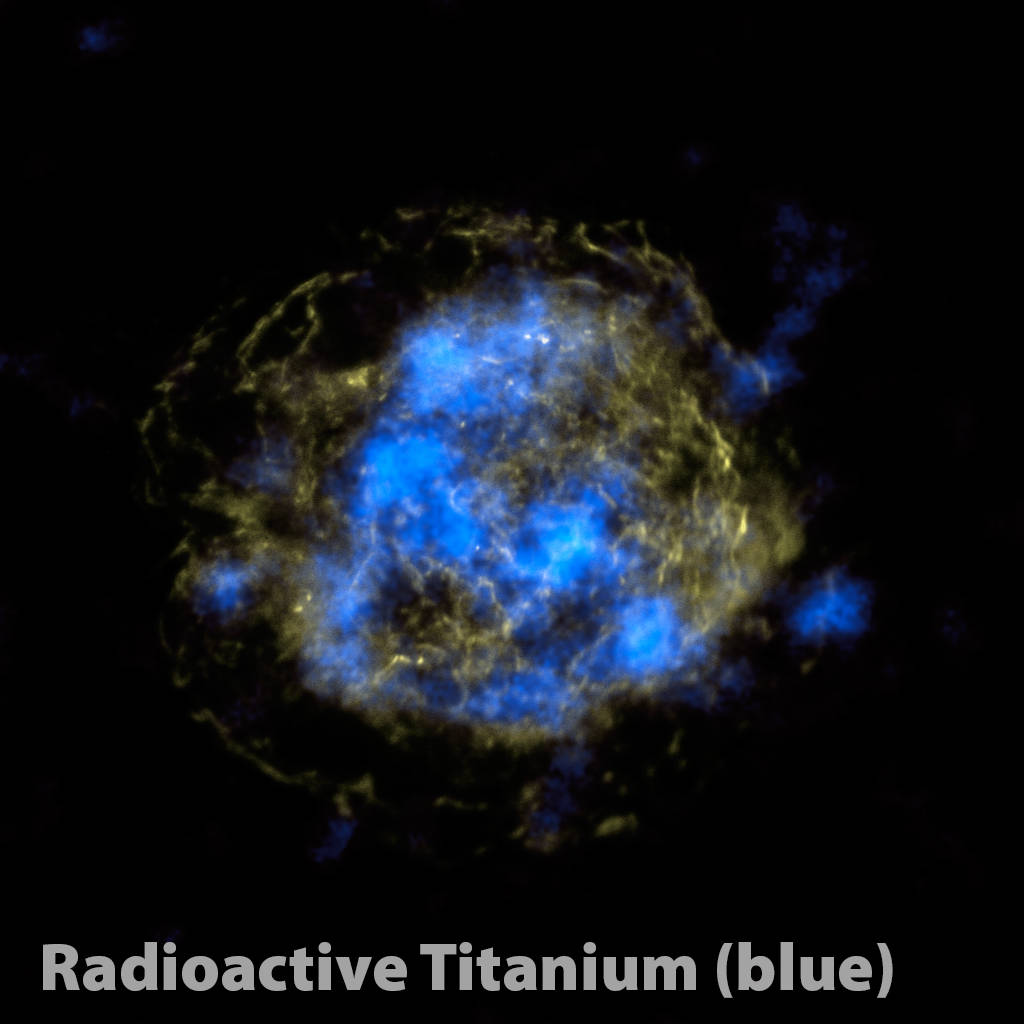
NASA’s Nuclear Spectroscope Telescope Array, or NuSTAR, has, for the first time, imaged the radioactive “guts” of a supernova remnant, the leftover remains of a star that exploded. The NuSTAR data are blue, and show high-energy X-rays. Yellow shows non-radioactive material detected previously by NASA’s Chandra X-ray Observatory in low-energy X-rays.
Studying radioactive elements offers astronomers a more direct method for probing supernova blasts than observing non-radioactive elements. This is because this radioactive material glows with X-rays no matter what, while the X-rays detected by Chandra and other telescopes are generated only after heating with shock waves from the explosion. Because the non-radioactive material only lights up after the explosion, it does not offer a direct look at the blast itself.
The NuSTAR results show that titanium is concentrated in clumps at the heart of the star, pointing to a model of supernova explosions that calls for sloshing of the inner core. This sloshing, also known as mild asymmetries, is thought to help trigger stars to ultimately detonate and fling out their outer layers.
Image credit: NASA/JPL-Caltech/CXC/SAO