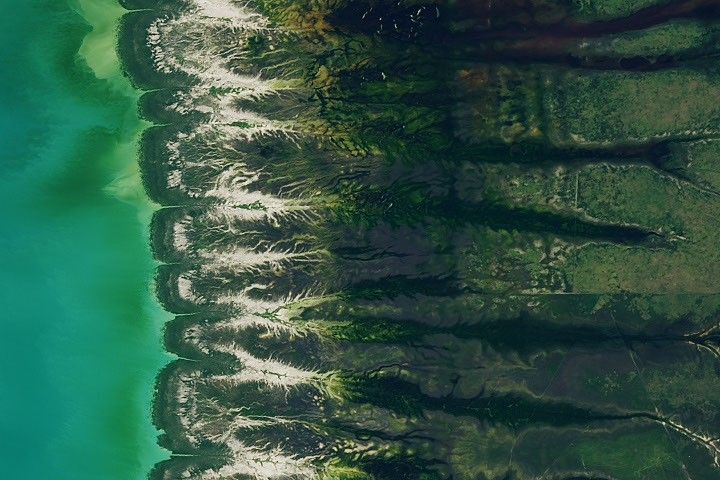
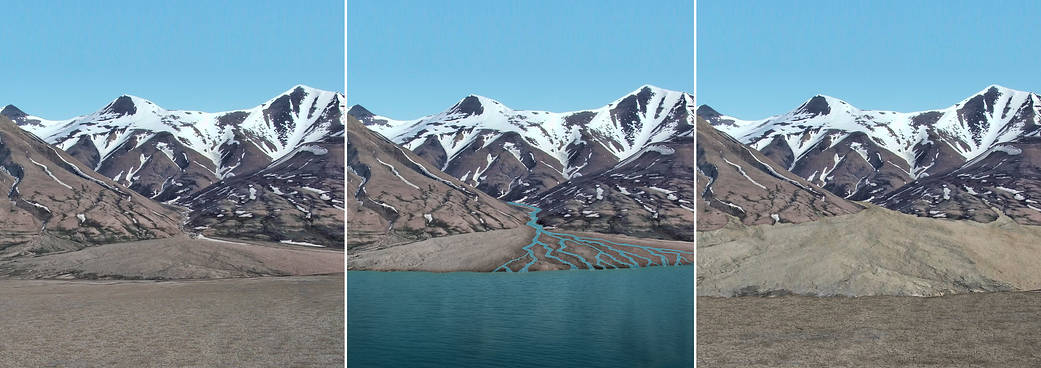
This series of images reconstructs the geology of the region around Mars’ Mount Sharp, where NASA’s Curiosity Mars rover landed and is now driving. The images, taken on Earth, have been altered for the illustration.
The mountain range serves as the rim of Gale Crater, the crater that surrounds Mount Sharp. In Mars’ past, almost 4 billion years ago, water from snowmelt flowed down the mountain, creating an alluvial fan, delta and lake basin. The region oscillated between wet and dry periods, as illustrated here. A dry period is shown at left, during which rocks in the mountains weather away, creating sediment that is transported down the once-wet river system. The middle panel shows a wet period, where water is flowing. Sediments are transported, building up the fan, delta, and lake floor. In the subsequent dry period shown at right, the water is gone. The exposed fan and lake floor are now at higher elevations due to the transport of sediment during the previous wet period.
This infilling process by sediments, a phenomenon known to occur in topographic basins on Earth, provides a hypothesis for how the lower part of Gale Crater became filled up to a depth of hundreds of yards (meters) or even a kilometer (0.6 mile).
For more information about the Mars Science Laboratory mission and the mission’s Curiosity rover, visit https://www.nasa.gov/msl and http://mars.jpl.nasa.gov/msl.
Image credit: NASA/JPL-Caltech