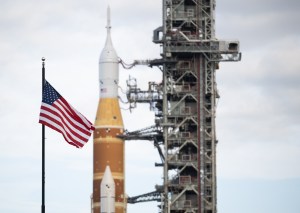

On Jan. 8, 2014, Orbital Sciences Corp. elected to scrub that day’s launch attempt of an Antares rocket from NASA’s Wallops Flight Facility, Wallops Island, Va., due to unusually high levels of space radiation – an example of the ways in which space weather can affect human technology.
Monitoring for space radiation – which refers to excessive high-energy protons in near-Earth space, often funneled in from space in association with an event on the sun such as the solar flares and associated coronal mass ejections that occurred on Jan. 7, 2014 – is a standard protocol for any launch attempt. Excess radiation can affect the critical computer systems aboard the launch vehicle.
“The launch vehicle avionics do everything from guiding the rocket, to telling it when to start up, to moving it through the various stages, to communicating with the payload prior to the payload being ejected,” said Chris St. Cyr, a space weather scientist at NASA’s Goddard Space Flight Center in Greenbelt, Md. “If there’s too much radiation these crucial systems could be damaged.”
There are two ways that the radiation can cause problems. First, a single well-aimed proton can interfere with the electronic systems, causing circuit damage or system shut downs. Second, a strong dose of radiation can cause degradation of microelectronics. Such radiation effects are also of concern to satellites that orbit high above Earth, and in the face of a strong proton storm spacecraft operators sometimes put their spacecraft into safe mode for added protection.
Launches, however, are simply postponed. As the radiation subsides, the Antares launch team will determine a new launch date and time.
For more on space weather effects:
https://www.nasa.gov/mission_pages/sunearth/spaceweather/index.html
For updates on the Antares launch:
https://www.nasa.gov/centers/wallops/home/index.html
For information on the solar event causing launch postponement:
https://www.nasa.gov/content/goddard/sun-unleashes-first-x-class-flare-of-2014/
Karen C. Fox
NASA’s Goddard Space Flight Center, Greenbelt, Md.