
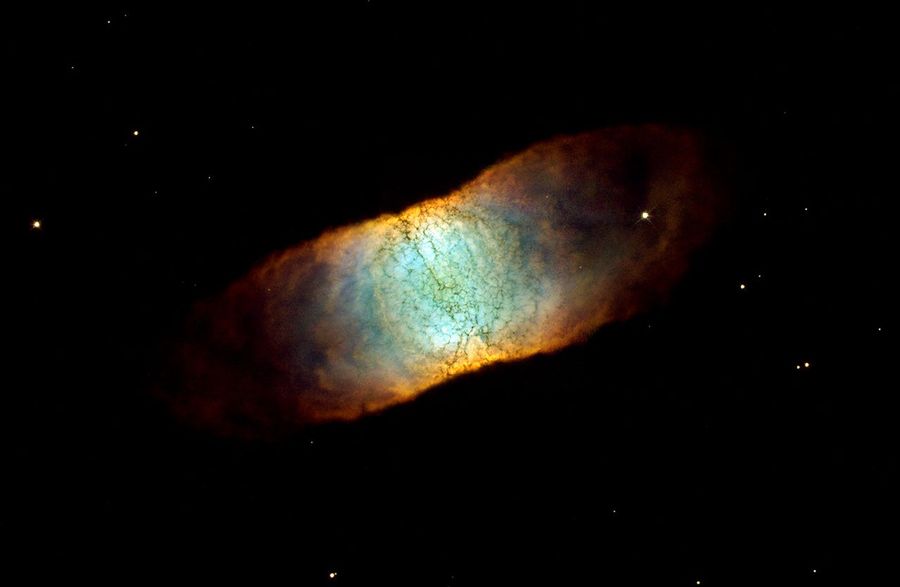
A dying star, IC 4406, dubbed the "Retina Nebula" is revealed in this month's Hubble Heritage image. Like many other so-called planetary nebulae, IC 4406 exhibits a high degree of symmetry; the left and right halves of the Hubble image are nearly mirror images of the other. If...
The Hubble telescope reveals a rainbow of colors in this dying star, called IC 4406. Like many other so-called planetary nebulae, IC 4406 exhibits a high degree of symmetry. The nebula's left and right halves are nearly mirror images of the other. If we could fly around IC 4406 in a spaceship, we would see that the gas and dust form a vast donut of material streaming outward from the dying star. We don't see the donut shape in this photograph because we are viewing IC 4406 from the Earth-orbiting Hubble telescope. From this vantage point, we are seeing the side of the donut. This side view allows us to see the intricate tendrils of material that have been compared to the eye's retina. In fact, IC 4406 is dubbed the "Retina Nebula."