
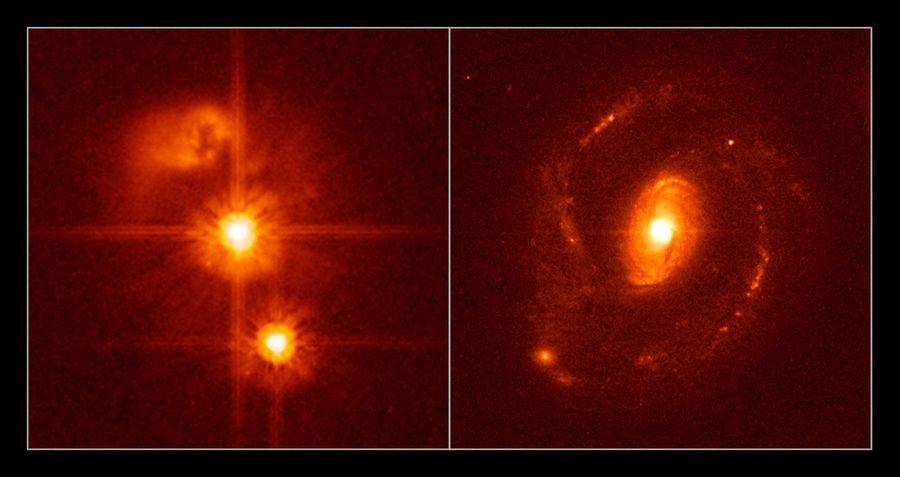
A team of European astronomers has used two of the most powerful astronomical facilities available, NASA's Hubble Space Telescope and the European Southern Observatory's (ESO) Very Large Telescope (VLT) at Cerro Paranal, to find a bright quasar without a massive host galaxy. Quasars are powerful and typically very distant sources of prodigious amounts of radiation. They are commonly associated with galaxies containing an active central black hole.
The team conducted a detailed study of 20 relatively nearby quasars. For 19 of them, they found, as expected, that these supermassive black holes are surrounded by a host galaxy. But when they studied the bright quasar HE0450-2958, located some 5 billion light-years away, they could not find evidence for a host galaxy. This, the astronomers suggest, may indicate a rare case of collision between a seemingly normal spiral galaxy and a much more exotic object harboring a very massive black hole.
The paper on HE0450-2958 will be published in the Sept. 15, 2005 issue of Nature.