
Stare deeply at these galaxies. They appear as if blood is pumping through the top of a flesh-free face. The long, ghastly “stare” of their searing eye-like cores shines out into the supreme cosmic darkness.
It’s good fortune that looks can be deceiving.
These galaxies have only grazed one another to date, with the smaller spiral on the left, cataloged as IC 2163, ever so slowly “creeping” behind NGC 2207, the spiral galaxy at right, millions of years ago.
The pair’s macabre colors represent a combination of mid-infrared light from NASA’s James Webb Space Telescope with visible and ultraviolet light from NASA’s Hubble Space Telescope.
Image: Galaxies IC 2163 and NGC 2207 (Webb and Hubble Image)
Look for potential evidence of their “light scrape” in the shock fronts, where material from the galaxies may have slammed together. These lines represented in brighter red, including the “eyelids,” may cause the appearance of the galaxies’ bulging, vein-like arms.
The galaxies’ first pass may have also distorted their delicately curved arms, pulling out tidal extensions in several places. The diffuse, tiny spiral arms between IC 2163’s core and its far left arm may be an example of this activity. Even more tendrils look like they’re hanging between the galaxies’ cores. Another extension “drifts” off the top of the larger galaxy, forming a thin, semi-transparent arm that practically runs off screen.
Image: Galaxies IC 2163 and NGC 2207 (MIRI Image)
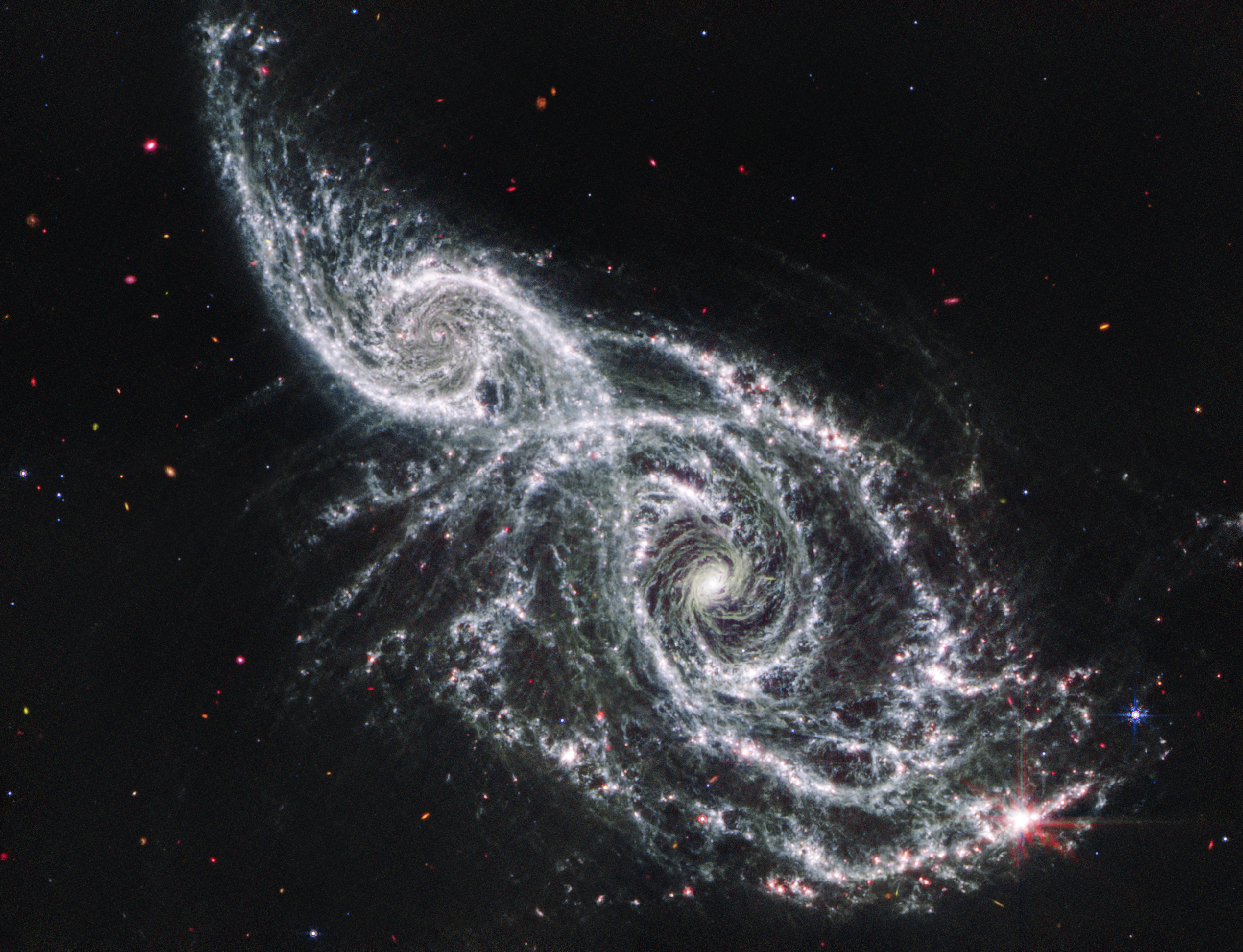
Both galaxies have high star formation rates, like innumerable individual hearts fluttering all across their arms. Each year, the galaxies produce the equivalent of two dozen new stars that are the size of the Sun. Our Milky Way galaxy only forms the equivalent of two or three new Sun-like stars per year. Both galaxies have also hosted seven known supernovae in recent decades, a high number compared to an average of one every 50 years in the Milky Way. Each supernova may have cleared space in their arms, rearranging gas and dust that later cooled, and allowed many new stars to form.
To spot the star-forming “action sequences,” look for the bright blue areas captured by Hubble in ultraviolet light, and pink and white regions detailed mainly by Webb’s mid-infrared data. Larger areas of stars are known as super star clusters. Look for examples of these in the top-most spiral arm that wraps above the larger galaxy and points left. Other bright regions in the galaxies are mini starbursts — locations where many stars form in quick succession. Additionally, the top and bottom “eyelid” of IC 2163, the smaller galaxy on the left, is filled with newer star formation and burns brightly.