

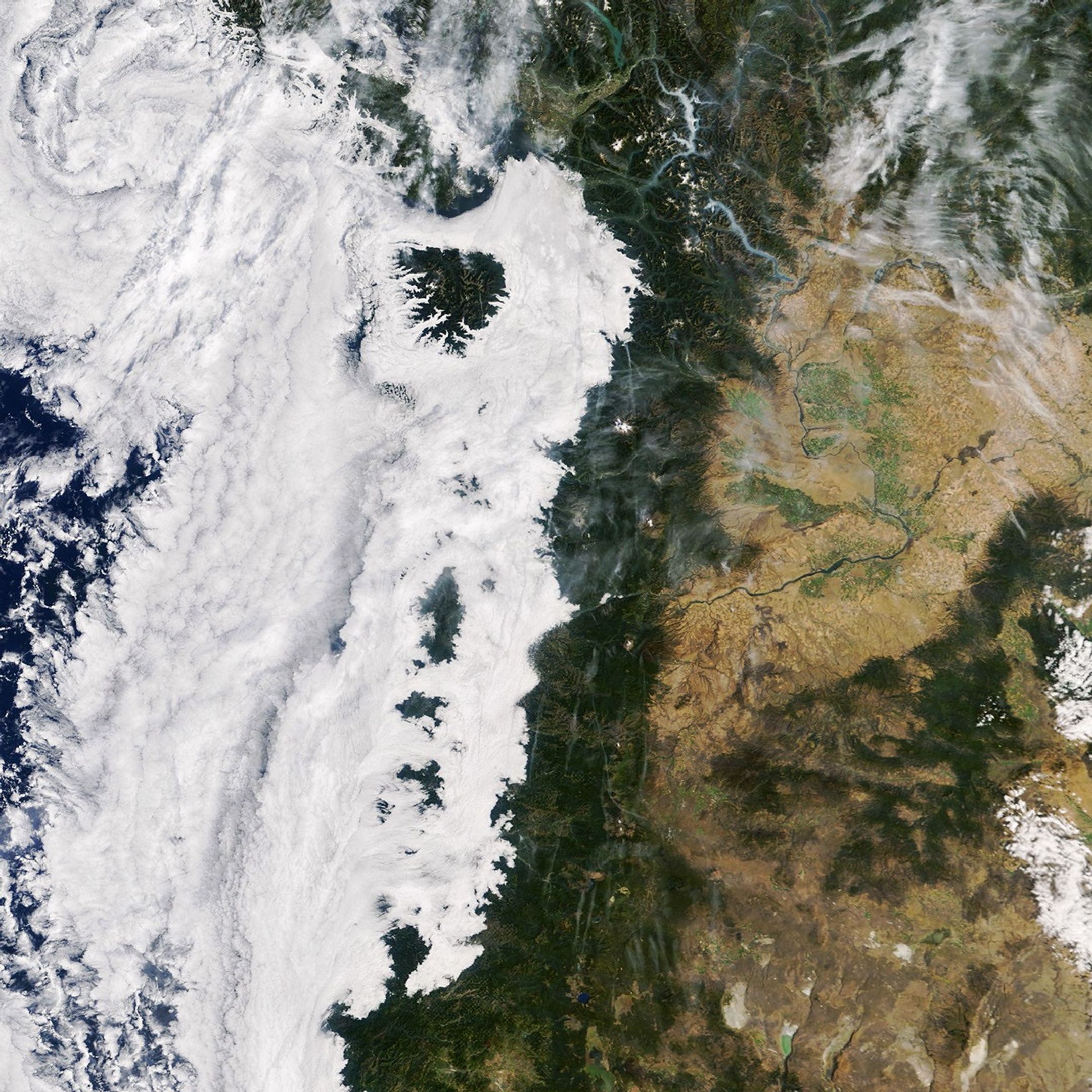
Cool, marine air rolling off the Pacific Ocean led to a picturesque layer of morning clouds over western Washington and Oregon in mid-September 2026. Low-lying stratus clouds and fog extended as far inland as the western foothills of the Cascade Range. Near the coast, taller portions of the Olympic Mountains in Washington and the Oregon Coast Range appeared island-like, protruding above the cloud layer.
The MODIS (Moderate Resolution Imaging Spectroradiometer) on NASA’s Terra satellite shows the extent of the Pacific Northwest’s cloudy cloak on September 19, 2026, at about 10:45 a.m. Pacific Time (17:45 Universal Time). Abundant clouds also appear offshore over the Pacific, while smoke from wildland fires fills valleys in the North Cascades.
For several nights in a row, marine air flowed onshore, according to the National Weather Service, bringing with it low-level clouds known as marine stratus. These clouds form when moist air near the surface, trapped beneath a warmer air layer in a temperature inversion, cools enough for its water vapor to condense. The surge of cool, moist conditions was particularly strong early on September 19, producing cloudy conditions all the way up to the Cascade foothills. Some areas witnessed foggy conditions, where clouds extended down to the ground.
That same day, when NASA's Aqua satellite passed over the area at about 4:15 p.m. Pacific Time (23:15 Universal Time), skies had cleared over much of the area. However, some marine clouds still clung to the Oregon coast, where temperatures stayed cooler than inland locations.
NASA Earth Observatory image by Michala Garrison, using MODIS data from NASA EOSDIS LANCE and GIBS/Worldview. Story by Lindsey Doermann.
References & Resources
- Dye, A. W., et al. (2020). Spatial patterns and trends of summertime low cloudiness for the Pacific Northwest, 1996–2017. Geophysical Research Letters, 47, e2020GL088121.
- EUMeTrain, Fog and Stratus. Accessed September 23, 2026.
- NASA Earth Observatory (2016, December 20) A Celebration of Clouds From Space, Earth Has an Elegant Atmosphere. Accessed September 23, 2026.
- National Weather Service, What are Marine Layer Clouds and How Do they Form? Accessed September 23, 2026.
- National Weather Service Portland, OR (2026, September 23) Area Forecast Discussion. Accessed September 23, 2026.
- National Weather Service Seattle WA (2026, September 23) Area Forecast Discussion. Accessed September 23, 2026.