
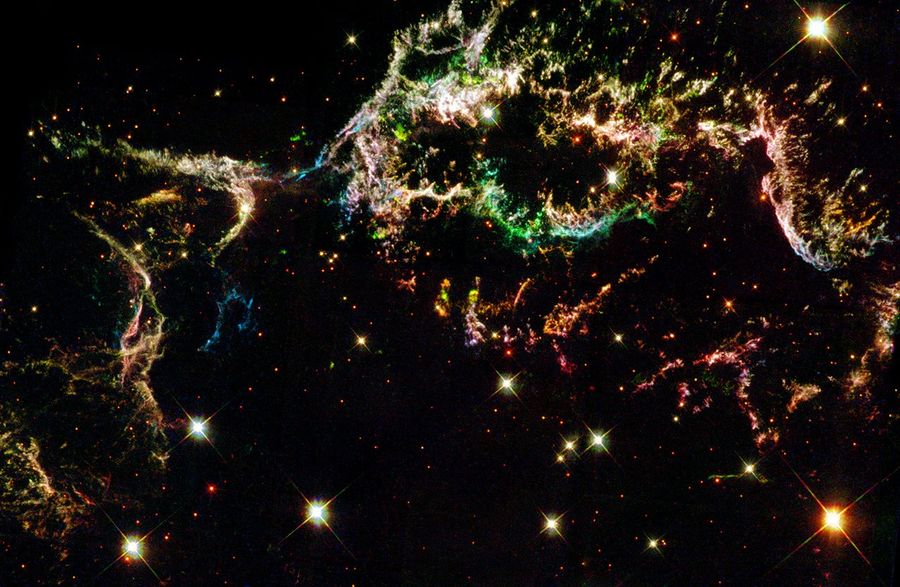
Glowing gaseous streamers of red, white, and blue – as well as green and pink – illuminate the heavens like Fourth of July fireworks. The colorful streamers that float across the sky in this photo taken by NASA's Hubble Space Telescope were created by the universe's biggest firecracker, the titanic supernova explosion of a massive star. The light from the exploding star reached Earth 320 years ago, nearly a century before our United States celebrated its birth with a bang. The dead star's shredded remains are called Cassiopeia A, or "Cas A" for short. Cas A is the youngest known supernova remnant in our Milky Way Galaxy and resides 10,000 light-years away in the constellation Cassiopeia, so the star actually blew up 10,000 years before the light reached Earth in the late 1600s.
Colorful Fireworks Finale Caps a Star’s Life
Glowing gaseous streamers of red, white, and blue – as well as green and pink – illuminate the heavens like Fourth of July fireworks. The colorful streamers that float across the sky in this photo taken by NASA’s Hubble Space…
NASA
Agência Espacial Americana
NOTÍCIAS RELACIONADAS

Curiosity Blog, Sols 4968-4974: Rock Climbing Towards the Discontinuity
Written by Lucy Lim, Planetary Scientist at NASA’s Goddard Space Flight Center Earth planning date: Friday, July 31, 2026 As mentioned in the previous blog, Curiosity has been exploring a large-scale feature in Gale’s sedimentary record suspected to be an…
Ler mais
Bountiful Roebuck Bay
Tidal and seasonal shifts leave their mark on this crescent-shaped, productive bay in Western Australia’s Kimberley region.
Ler mais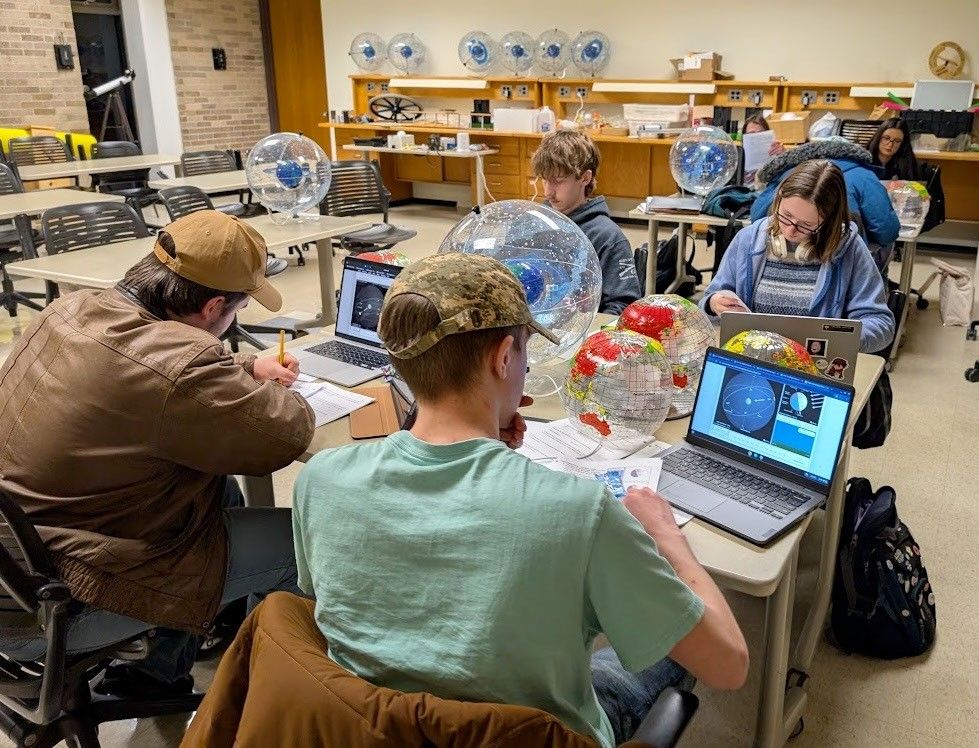
Community College Instructors Bring Astronomy Textbook Into 21st Century
Teaching the beautiful and inspirational science of astronomy using only the conceptual framework offered by a traditional textbook – without incorporating the wealth of incredible resources, images and activities from NASA – falls short of the more modern, active learning…
Ler mais