Two decades ago, astronomers spotted one of the brightest exploding stars in more than 400 years.
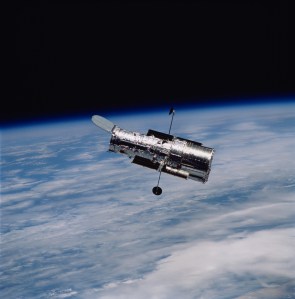
Since that first sighting, the doomed star, called Supernova 1987A, has continued to fascinate astronomers with its spectacular light show. NASA's Hubble Space Telescope is one of many observatories that has been monitoring the blast's aftermath. The supernova is located 163,000 light-years away in the Large Magellanic Cloud.
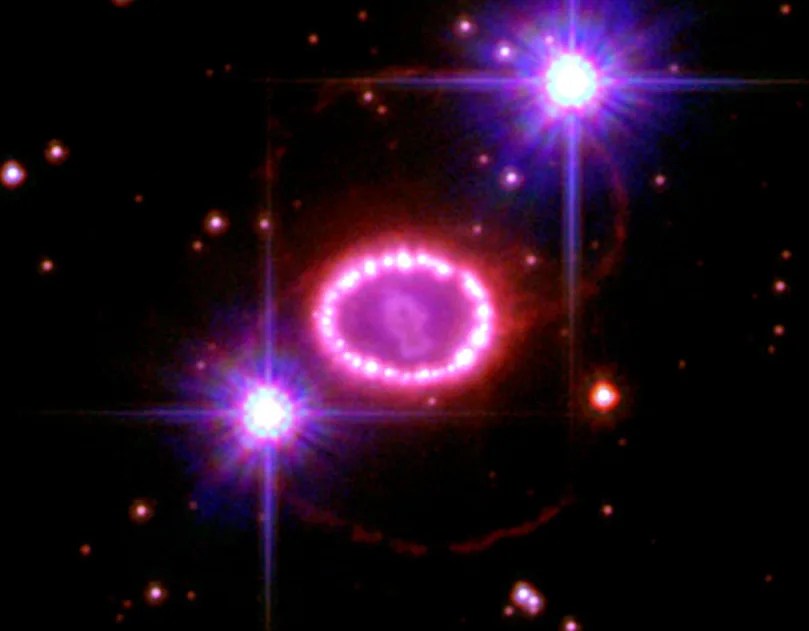
This image shows the entire region surrounding the supernova, the most prominent feature of which is a ring with dozens of bright spots, shining like cosmic pearls. Unleashed by the stellar blast, this material is slamming into regions along the ring's inner regions, heating them up, and causing them to glow. The ring, about a light-year across, was likely shed by the star about 20,000 years before it exploded.
This image was taken in December 2006 with Hubble's Advanced Camera for Surveys.
Image credit: NASA, ESA, P. Challis and R. Kirshner (Harvard-Smithsonian Center for Astrophysics)