

In the summer months in the Northern Hemisphere, dust storms originating inthe deserts around the Arabian Peninsula have a significant impact on theamount of solar radiation that reaches the surface. Winds sweep desert sandsinto the air and transport them eastward toward India and Asia with theseasonal monsoon. These airborne particles absorb and deflect incomingradiation and can produce a cooling effect as far away as North America.
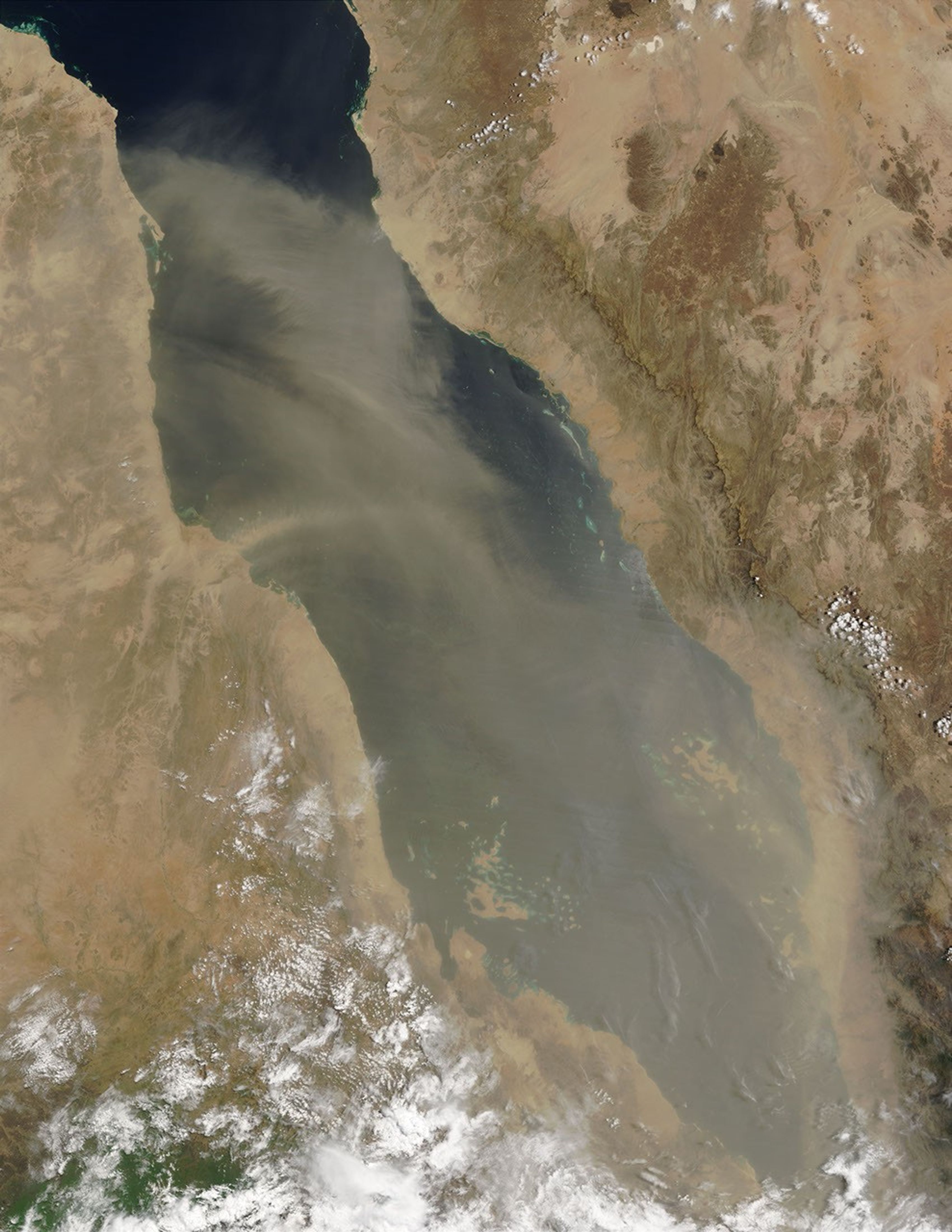
According to calculations performed by the NASA Goddard Institutefor Space Studies (GISS), the terrain surrounding the southern portionsof the Red Sea is one of the areas most dramatically cooled by the presenceof summertime dust storms. That region is shown experiencing a dust storm inthis true-color image from the Moderate Resolution Imaging Spectroradiometer (MODIS)acquired on July 11, 2002. The GISS model simulations indicate that betweenJune and August, the temperatures would be as much as 2 degrees Celsius warmer than theyare if it weren't for the dust in the air—a cooling equivalent to thepassage of a rain cloud overhead.
The image shows the African countries of Sudan (top left), Ethiopia (bottomleft), with Eritrea nestled between them along the western coast of the RedSea. Toward the right side of the image are Saudi Arabia (top) and Yemen (bottom) on the ArabianPeninsula. Overlooking the Red Sea, a long escarpment runs along the westernedge of the Arabian Peninsula, and in this image appears to be blocking thefull eastward expansion of the dust storm.
References & Resources
Image courtesy Jacques Descloitres, MODIS Land Rapid Response Team at NASA GSFC