BACKGROUND INFORMATION: HUBBLE TRIVIA 2006
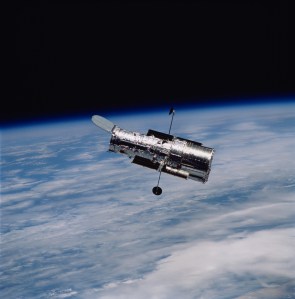
In its 16 years of viewing the sky, NASA's Hubble Space Telescope has taken roughly 750,000 exposures and probed about 24,000 celestial objects. Hubble does not travel to stars, planets and galaxies. It snaps pictures of them as it whirls around Earth. In its 16-year lifetime, the telescope has made nearly 93,500 trips around our planet, racking up almost 2.4 billion miles. That mileage is slightly more than a round trip to Saturn.
The telescope's observations have produced more than 27 terabytes of data, equal to roughly 400,000 compact discs. If those compact discs were stacked on top of each other, they would be more than three times taller than the Washington Monument in Washington, D.C.
Each day the orbiting observatory generates about 10 gigabytes of data, enough information to fill up the hard drive of a typical home computer n a week.
In Hubble's 16-year lifetime, about 4,000 astronomers from all over the world have used the telescope to probe the universe.
Astronomers have published more than 6,300 scientific papers on Hubble results.