
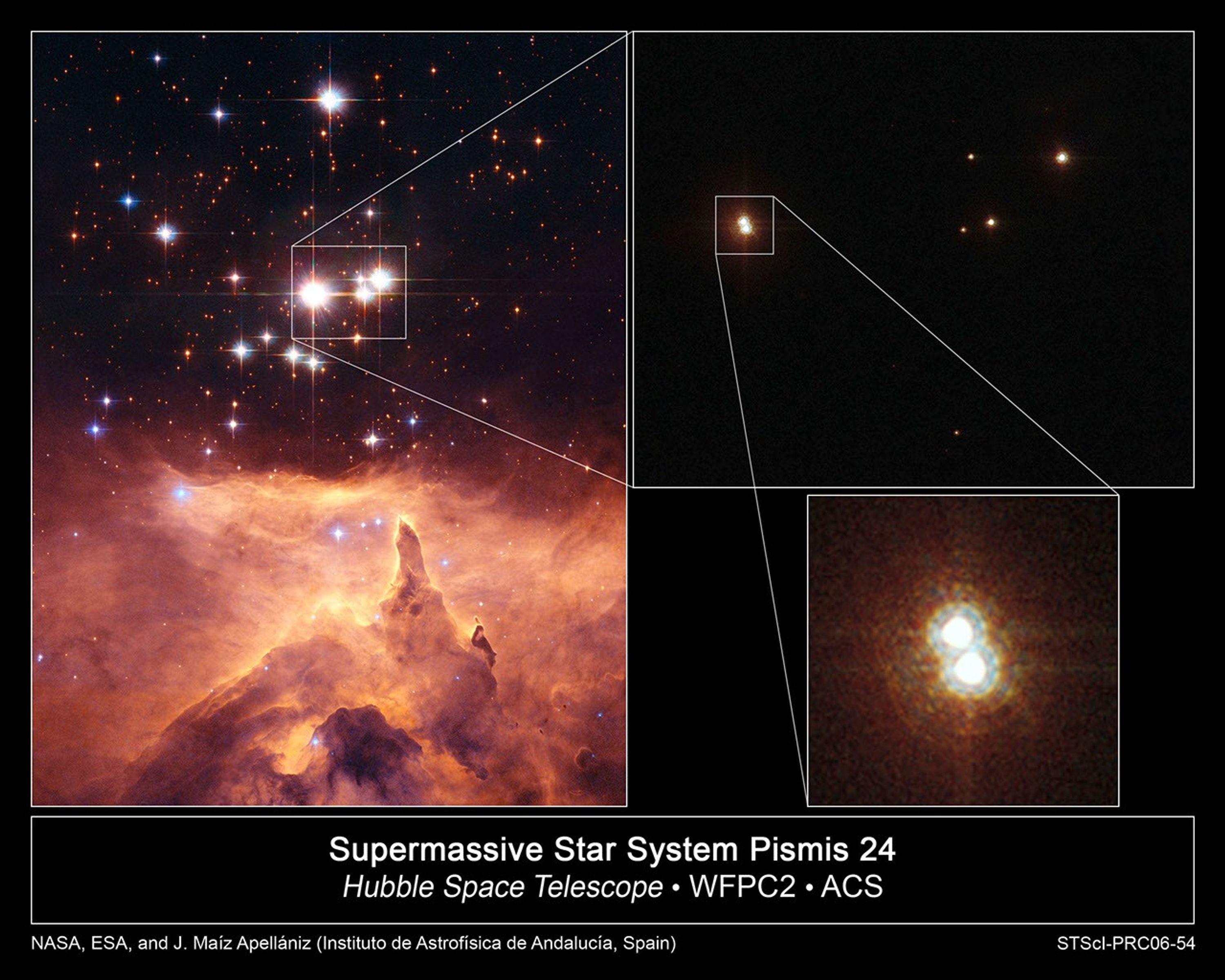
The small open star cluster Pismis 24 lies in the core of the large emission nebula NGC 6357 in Scorpius, about 8,000 light-years away from Earth. Some of the stars in this cluster are extremely massive and emit intense ultraviolet radiation. The brightest object in the picture is designated Pismis 24-1. It was once thought to weigh as much as 200 to 300 solar masses. This would not only have made it by far the most massive known star in the galaxy, but would have put it considerably above the currently believed upper mass limit of about 150 solar masses for individual stars. However, high-resolution Hubble Space Telescope images of the star show that it is really two stars orbiting one another (inset pictures at top right and bottom right). They are estimated to each be 100 solar masses. The Hubble Advanced Camera for Surveys images were taken in April 2006.
Heavyweight Stars Light Up Nebula NGC 6357
The small open star cluster Pismis 24 lies in the core of the large emission nebula NGC 6357 in Scorpius, about 8,000 light-years away from Earth. Some of the stars in this cluster are extremely massive and emit intense ultraviolet…
NASA
Agência Espacial Americana
NOTÍCIAS RELACIONADAS
NASA Competition Invites Students to Help Imagine a Future Enabled by Lunar Technologies
NASA is asking U.S.-based collegiate teams to submit bold, original concepts to the 2027 edition of a student challenge focused on aerospace innovation that could help the agency envision a future on the Moon shaped by new technology. The latest NASA Revolutionary Aerospace Systems Concepts…
Ler mais
Volunteer Develops Machine-Learning Tool to Identify Rare Clouds
Certain kinds of clouds are misbehaving – appearing more often and lower in the sky than they used to. To help identify the factors influencing these changes, scientists have asked people around the world with cameras to submit fresh images…
Ler mais
NASA’s COFFIES Uses AI to Predict Storm-Causing Active Regions on Sun
As humanity looks to the Moon and stars for future exploration, predicting space weather — conditions in space primarily driven by the Sun — is more important than ever. Now, a team of astrophysicists and data scientists with NASA’s COFFIES (Consequence…
Ler mais