
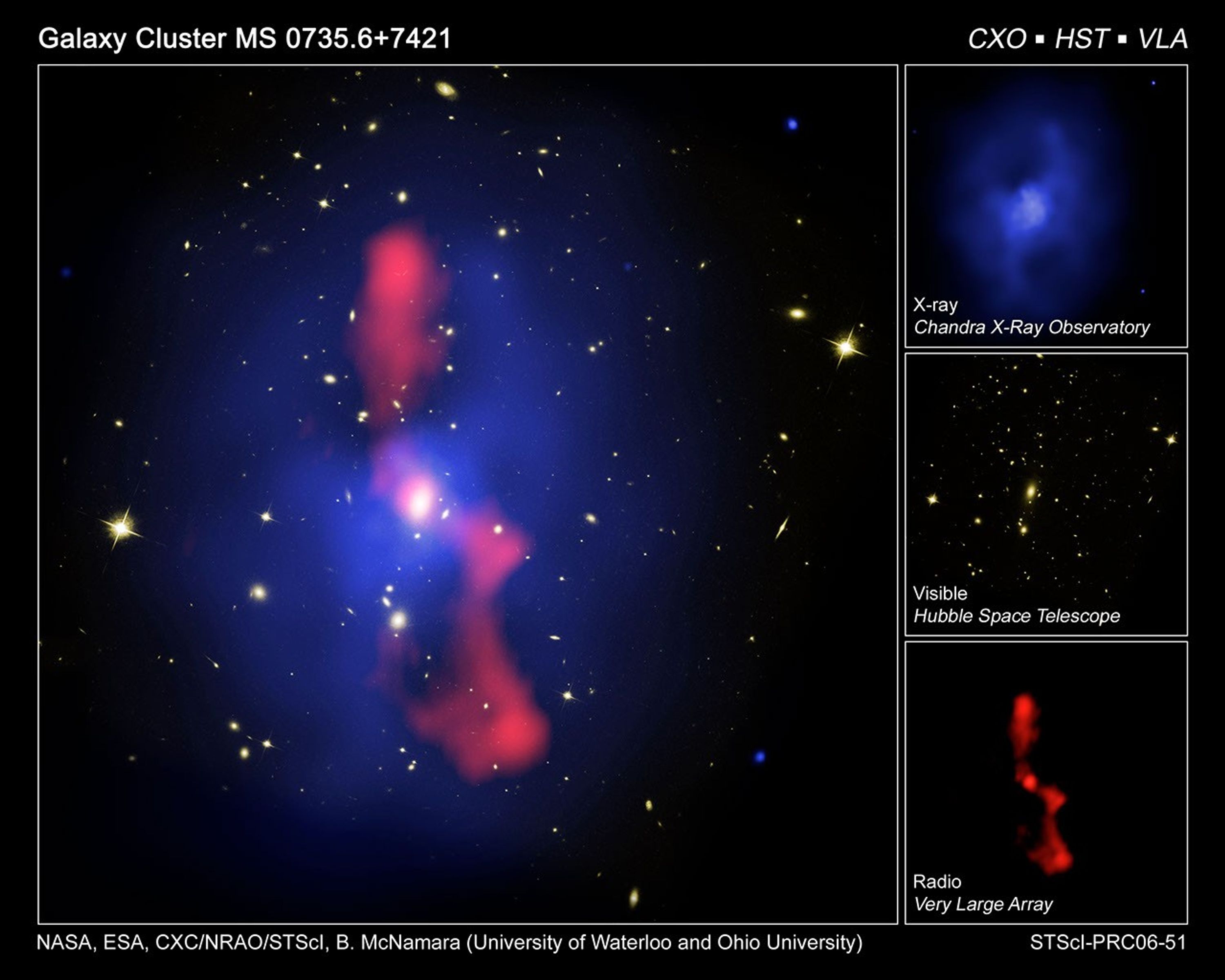
This is a new composite image of galaxy cluster MS0735.6+7421, located about 2.6 billion light-years away in the constellation Camelopardalis. The three views of the region were taken with NASA's Hubble Space Telescope in Feb. 2006, NASA's Chandra X-ray Observatory in Nov. 2003, and NRAO's Very Large Array in Oct. 2004. The Hubble image shows dozens of galaxies bound together by gravity. In Jan. 2005, astronomers reported that a supermassive black hole, lurking in the central bright galaxy, generated the most powerful outburst seen in the universe. The VLA radio image shows jets of high energy particles (in red) streaming from the black hole. These jets pushed the X-ray emitting hot gas (shown in blue in the Chandra image) aside to create two giant cavities in the gas. The cavities are evidence for the massive eruption. The X-ray and radio images show the enormous appetite of large black holes and the profound impact they have on their surroundings.
Host Galaxy Cluster to Largest Known Radio Eruption
This is a new composite image of galaxy cluster MS0735.6+7421, located about 2.6 billion light-years away in the constellation Camelopardalis. The three views of the region were taken with NASA’s Hubble Space Telescope in Feb. 2006, NASA’s Chandra X-ray Observatory…
NASA
Agência Espacial Americana
NOTÍCIAS RELACIONADAS
NASA Competition Invites Students to Help Imagine a Future Enabled by Lunar Technologies
NASA is asking U.S.-based collegiate teams to submit bold, original concepts to the 2027 edition of a student challenge focused on aerospace innovation that could help the agency envision a future on the Moon shaped by new technology. The latest NASA Revolutionary Aerospace Systems Concepts…
Ler mais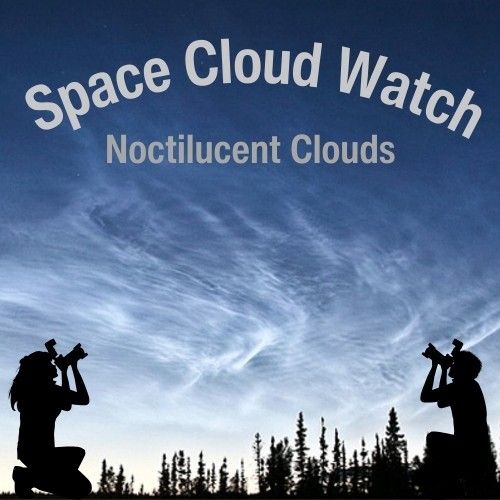
Volunteer Develops Machine-Learning Tool to Identify Rare Clouds
Certain kinds of clouds are misbehaving – appearing more often and lower in the sky than they used to. To help identify the factors influencing these changes, scientists have asked people around the world with cameras to submit fresh images…
Ler mais
NASA’s COFFIES Uses AI to Predict Storm-Causing Active Regions on Sun
As humanity looks to the Moon and stars for future exploration, predicting space weather — conditions in space primarily driven by the Sun — is more important than ever. Now, a team of astrophysicists and data scientists with NASA’s COFFIES (Consequence…
Ler mais