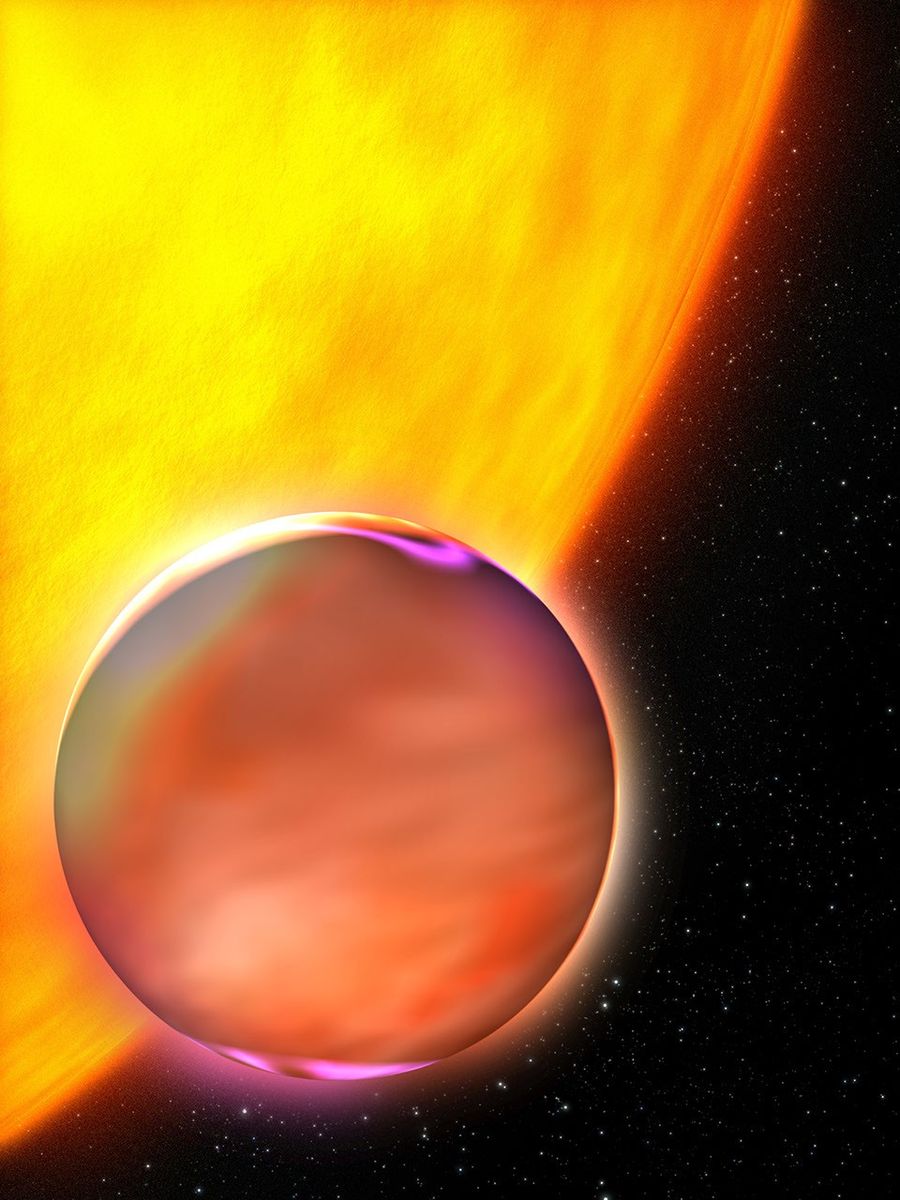
A team of astronomers, led by Frederic Pont from the Geneva University Observatory in Switzerland, has detected for the first time strong evidence of hazes in the atmosphere of a planet orbiting a distant star. The new Hubble Space Telescope observations were made as the extrasolar planet, dubbed HD 189733b, passed in front of its parent star in an eclipse. As the light from the star briefly passes through the exoplanet's atmosphere, the gases in the atmosphere stamp their unique spectral fingerprints on the starlight. Where the scientists had expected to see the fingerprints of sodium and potassium, there were none; implying that high-level hazes (with an altitude of nearly 2,000 miles) are responsible for blocking the light from these elements.
Hubble Finds that Extrasolar Planet Has a Hazy Sunset
A team of astronomers, led by Frederic Pont from the Geneva University Observatory in Switzerland, has detected for the first time strong evidence of hazes in the atmosphere of a planet orbiting a distant star. The new Hubble Space Telescope…
NASA
Agência Espacial Americana
NOTÍCIAS RELACIONADAS
NASA Competition Invites Students to Help Imagine a Future Enabled by Lunar Technologies
NASA is asking U.S.-based collegiate teams to submit bold, original concepts to the 2027 edition of a student challenge focused on aerospace innovation that could help the agency envision a future on the Moon shaped by new technology. The latest NASA Revolutionary Aerospace Systems Concepts…
Ler mais
Volunteer Develops Machine-Learning Tool to Identify Rare Clouds
Certain kinds of clouds are misbehaving – appearing more often and lower in the sky than they used to. To help identify the factors influencing these changes, scientists have asked people around the world with cameras to submit fresh images…
Ler mais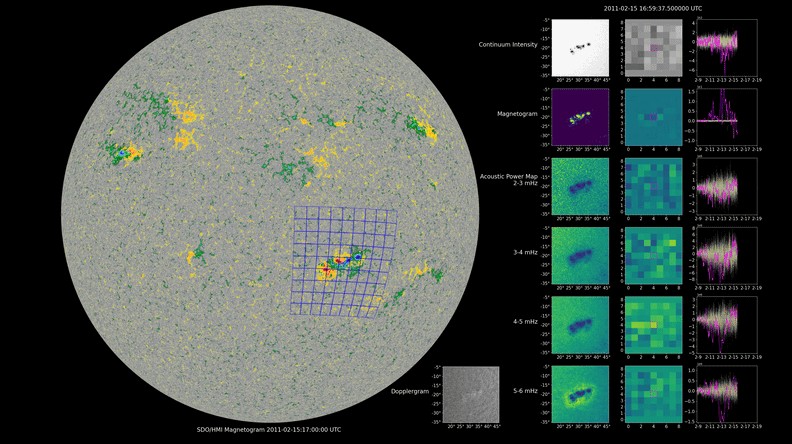
NASA’s COFFIES Uses AI to Predict Storm-Causing Active Regions on Sun
As humanity looks to the Moon and stars for future exploration, predicting space weather — conditions in space primarily driven by the Sun — is more important than ever. Now, a team of astrophysicists and data scientists with NASA’s COFFIES (Consequence…
Ler mais