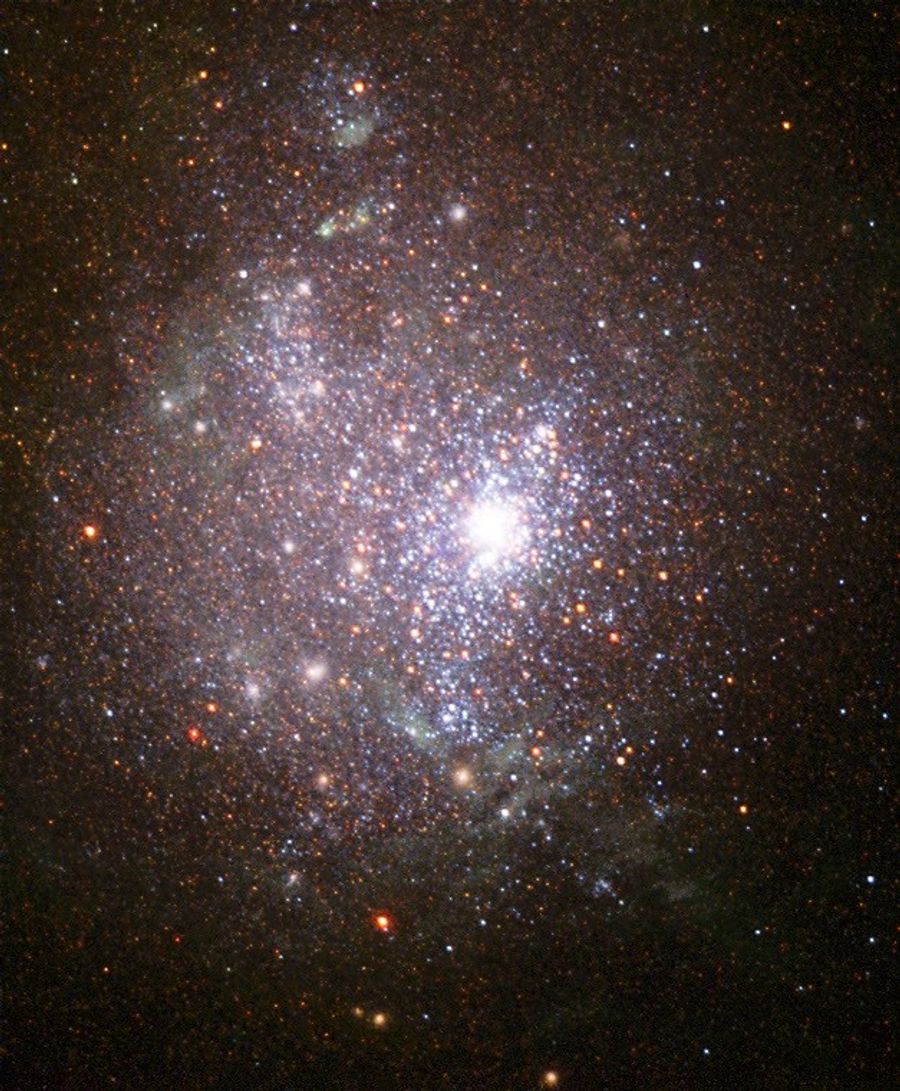
The central region of the small galaxy NGC 1705 blazes with the light of thousands of young and old stars in this image, taken by NASA's Hubble Space Telescope. At 17 million light-years away, the individual stars of the dwarf irregular galaxy NGC 1705 are out of range of all but the sharp eyes of Hubble. NGC 1705 is classified as a dwarf irregular because it is small and lacks any regular structure.

Hubble Resolves a Blaze of Stars in a Galaxy’s Core
The central region of the small galaxy NGC 1705 blazes with the light of thousands of young and old stars in this image, taken by NASA’s Hubble Space Telescope. At 17 million light-years away, the individual stars of the dwarf…

NASA
Agência Espacial Americana
NOTÍCIAS RELACIONADAS

Stops Along the Path of Totality
Western Iceland and northern Spain are among the few Northern Hemisphere locations experiencing a total solar eclipse on August 12, 2026.
Ler mais
What Is the Nancy Grace Roman Space Telescope? (Grades 5-8)
This article is for students grades 5-8. The Nancy Grace Roman Space Telescope is NASA’s newest astrophysics observatory. The telescope will scan large sections of space. Roman will help astronomers answer questions about dark energy, dark matter, exoplanets, and more. ______________________________________________________________________…
Ler mais
NASA Completes Astronaut-Deployed Science Instrument for Lunar Surface
NASA has declared “wrenches down” on the first completed payload designed for Artemis astronauts to deploy on the Moon’s surface. Engineers working on NASA’s Lunar Environment Monitoring Station, or LEMS, have completed hardware development and testing and the payload is…
Ler mais