In the Jupiter campaign, scientists wanted to see how the comet collisions affected the Jovian aurorae, rapid and irregular displays of colorful light in a planet's night sky caused by the leakage of charged particles from the magnetosphere into the atmosphere. Following the...
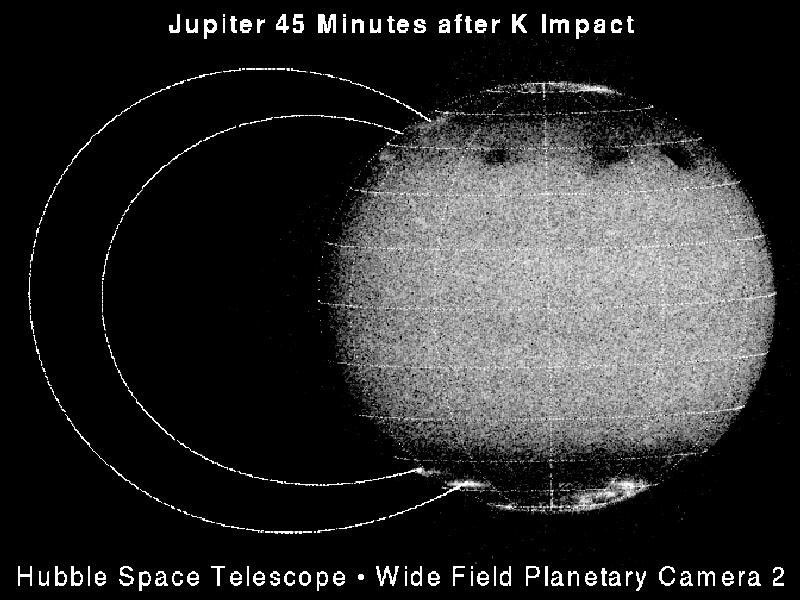
In the Jupiter campaign, scientists wanted to see how the comet collisions affected the Jovian aurorae, rapid and irregular displays of colorful light in a planet's night sky caused by the leakage of charged particles from the magnetosphere into the atmosphere. Following the impacts, some of the resulting debris became electrically charged and traveled along Jupiter's magnetic field lines and created new aurorae in Jupiter's northern hemisphere, as shown in this image. Scientists had never before observed aurorae this far south of where aurorae are typically seen in Jupiter's northern hemisphere.