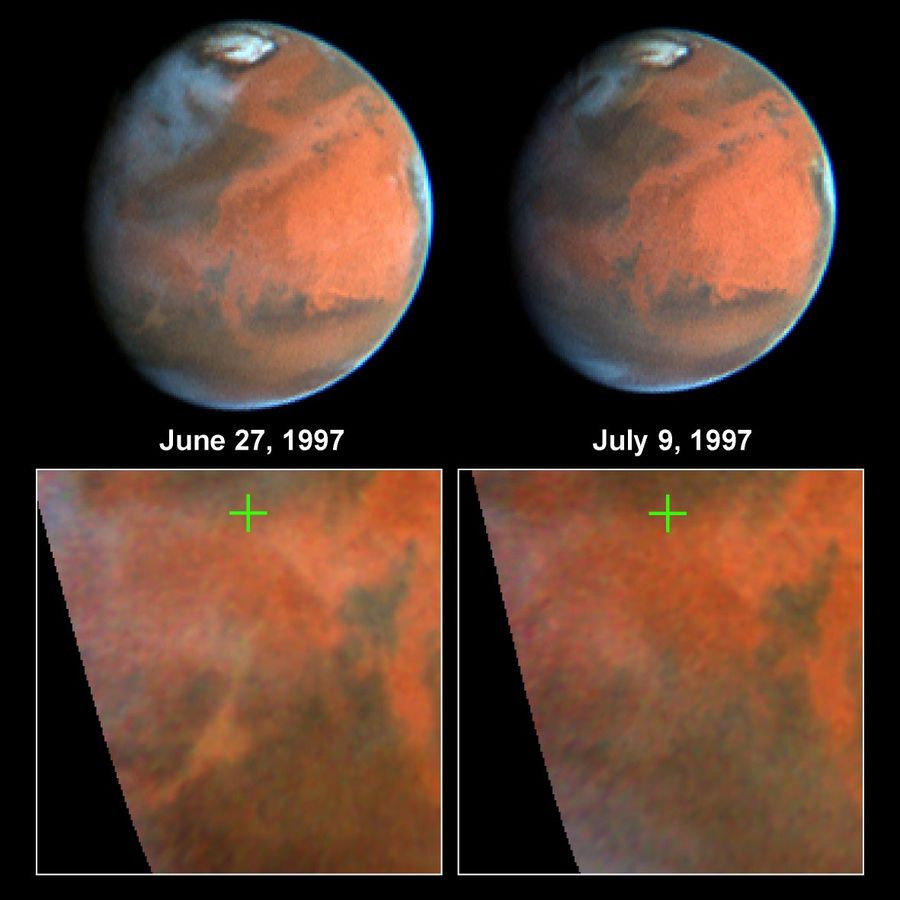
Astronomers using NASA's Hubble Space Telescope to track weather on Mars, and how it might affect the Pathfinder landing site in Ares Vallis, report that a large dust storm seen south of the site only 12 days earlier has dissipated. However a new dust storm has appeared in the polar region, about 2000 km (1200 miles) due north of Pathfinder.
The Hubble researchers conclude that Pathfinder landed during a period when large changes in the regional distributions of dust and clouds were taking place on Mars.
Hubble pictures taken with the Wide Field Planetary Camera 2 recorded remarkable daily changes in the behavior of dust and water-ice clouds on the red planet as followed over a three-day period, from July 9 to 11. The variability seen in just three consecutive days of Mars observations shows that weather changes are very rapid - possibly chaotic - so it may be impractical to make an accurate weather forecast for Mars, say researchers. "Mars never ceases to amaze us," says Steve Lee of the University of Colorado at Boulder, Colorado.
The team suggests that the dust seen in the skies over Pathfinder may have diffused toward the landing site from the now dissipated dust storm in Valles Marineris. The newly erupted 600 mile-long dust "streamer" coming off the northern polar cap, and extending southward, may also be sending dust toward the Pathfinder landing site.
The Hubble Mars Team: Phil James, Mike Wolff (University of Toledo), Steve Lee (University of Colorado), Todd Clancy (Space Science Institute), James Bell III (Cornell University).