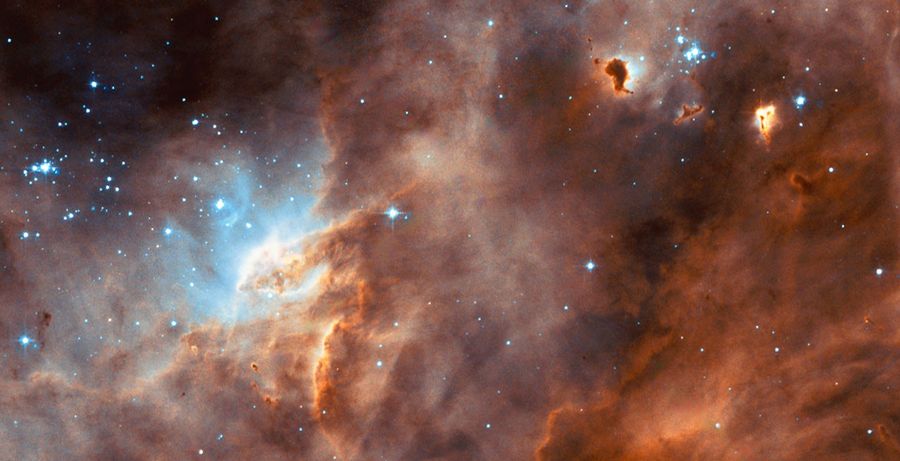
NASA's Hubble Space Telescope captures this iridescent tapestry of star birth in a neighboring galaxy in this panoramic view of glowing gas, dark dust clouds, and young, hot stars. The star-forming region, catalogued as N11B, lies in the Large Magellanic Cloud (LMC), located...
NASA's Hubble Space Telescope captures the iridescent tapestry of star birth in a neighboring galaxy in this panoramic view of glowing gas, dark dust clouds, and young, hot stars. The star-forming region, catalogued as N11B, lies in the Large Magellanic Cloud (LMC), located only 160,000 light-years from Earth. With its high resolution, the Hubble Space Telescope is able to view details of star formation in the LMC as easily as ground-based telescopes are able to observe stellar formation within our own Milky Way galaxy.