
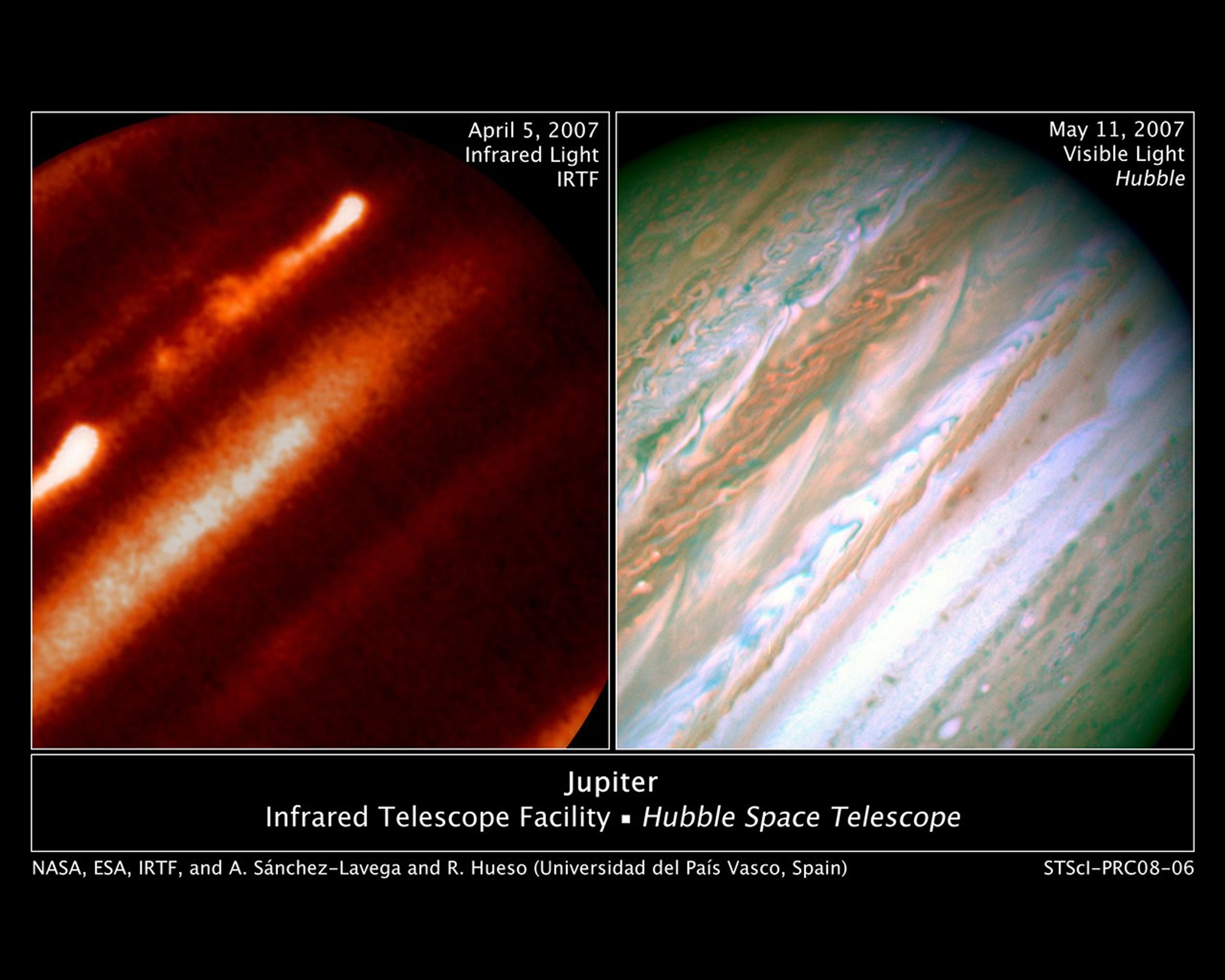
Detailed analysis of two continent-sized storms that erupted in Jupiter's atmosphere in March 2007 shows that Jupiter's internal heat plays a significant role in generating atmospheric disturbances. Understanding this outbreak could be the key to unlock the mysteries buried in the deep Jovian atmosphere. An international team coordinated by Agustin Sánchez-Lavega from the Universidad del País Vasco in Spain presents its findings about this event in the January 24 issue of the journal Nature. The team monitored the new eruption of cloud activity and its evolution with an unprecedented resolution using NASA's Hubble Space Telescope, the NASA Infrared Telescope Facility in Hawaii, and telescopes in the Canary Islands (Spain). A network of smaller telescopes around the world also supported these observations.
Internal Heat Drives Jupiter’s Giant Storm Eruption
Detailed analysis of two continent-sized storms that erupted in Jupiter’s atmosphere in March 2007 shows that Jupiter’s internal heat plays a significant role in generating atmospheric disturbances. Understanding this outbreak could be the key to unlock the mysteries buried in…
NASA
Agência Espacial Americana
NOTÍCIAS RELACIONADAS
NASA Competition Invites Students to Help Imagine a Future Enabled by Lunar Technologies
NASA is asking U.S.-based collegiate teams to submit bold, original concepts to the 2027 edition of a student challenge focused on aerospace innovation that could help the agency envision a future on the Moon shaped by new technology. The latest NASA Revolutionary Aerospace Systems Concepts…
Ler mais
Volunteer Develops Machine-Learning Tool to Identify Rare Clouds
Certain kinds of clouds are misbehaving – appearing more often and lower in the sky than they used to. To help identify the factors influencing these changes, scientists have asked people around the world with cameras to submit fresh images…
Ler mais
NASA’s COFFIES Uses AI to Predict Storm-Causing Active Regions on Sun
As humanity looks to the Moon and stars for future exploration, predicting space weather — conditions in space primarily driven by the Sun — is more important than ever. Now, a team of astrophysicists and data scientists with NASA’s COFFIES (Consequence…
Ler mais