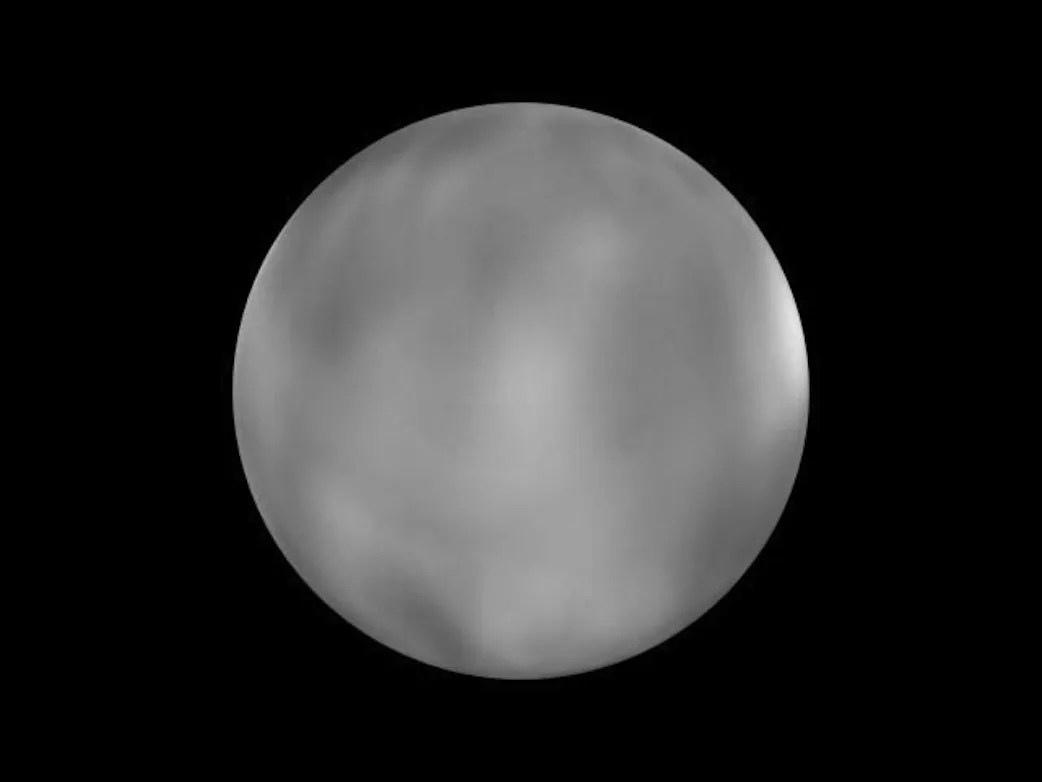
New observations of Ceres, the largest known asteroid, have revealed that the object may be a "mini-planet," and may contain large amounts of pure water ice beneath its surface.
The observations by NASA's Hubble Space Telescope also show that Ceres shares characteristics of the rocky, terrestrial planets like Earth. Ceres' shape is almost round like Earth's, suggesting that the asteroid may have a rocky inner core and a thin, dusty outer crust.
Hubble studied Ceres for a full nine-hour rotational period, the most complete view of the celestial body to date.
Image Credit: NASA, ESA, J.-Y. Li (University of Maryland) and G. Bacon (STScI)
Mini-Planet?
New observations of Ceres, the largest known asteroid, have revealed that the object may be a “mini-planet,” and may contain large amounts of pure water ice beneath its surface. The observations by NASA’s Hubble Space Telescope also show that Ceres…

NASA
Agência Espacial Americana
NOTÍCIAS RELACIONADAS

NASA Competition Invites Students to Help Imagine a Future Enabled by Lunar Technologies
NASA is asking U.S.-based collegiate teams to submit bold, original concepts to the 2027 edition of a student challenge focused on aerospace innovation that could help the agency envision a future on the Moon shaped by new technology. The latest NASA Revolutionary Aerospace Systems Concepts…
Ler mais
Volunteer Develops Machine-Learning Tool to Identify Rare Clouds
Certain kinds of clouds are misbehaving – appearing more often and lower in the sky than they used to. To help identify the factors influencing these changes, scientists have asked people around the world with cameras to submit fresh images…
Ler mais
NASA’s COFFIES Uses AI to Predict Storm-Causing Active Regions on Sun
As humanity looks to the Moon and stars for future exploration, predicting space weather — conditions in space primarily driven by the Sun — is more important than ever. Now, a team of astrophysicists and data scientists with NASA’s COFFIES (Consequence…
Ler mais