
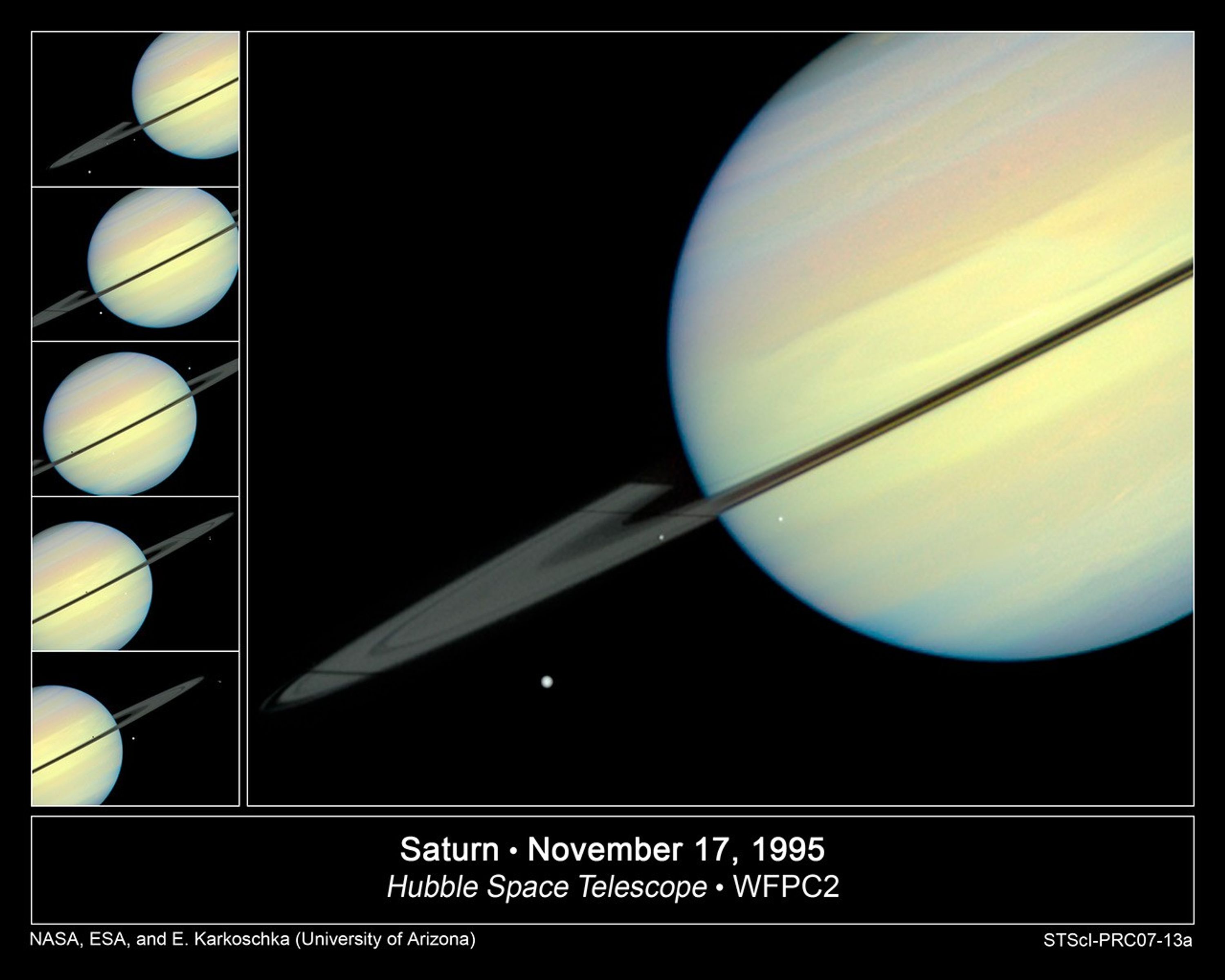
Photogenic Saturn has now become a movie star. Astronomers have woven NASA Hubble Space Telescope images of Saturn, its rings, and several of its moons into three movies. Each movie highlights unique times in the planet's 30-year waltz around the Sun. Two of the movies show the motion of several of Saturn's moons when the planet's rings were tilted nearly edge-on to Earth and to the Sun. These edge-on alignments of the rings occur roughly once every 15 years. Another movie presents a clear view of Saturn's Southern Hemisphere when the planet's rings were at maximum tilt toward Earth. Hubble snapped only about a dozen images during each of these three events, so astronomers created software to extend the photos into the hundreds of images needed for a movie. The images were taken with Hubble's Wide Field and Planetary Camera 2 in 1995 and the Advanced Camera for Surveys in 2003
Saturn Stars in Three Hubble Movies
Photogenic Saturn has now become a movie star. Astronomers have woven NASA Hubble Space Telescope images of Saturn, its rings, and several of its moons into three movies. Each movie highlights unique times in the planet’s 30-year waltz around the…
NASA
Agência Espacial Americana
NOTÍCIAS RELACIONADAS
NASA Competition Invites Students to Help Imagine a Future Enabled by Lunar Technologies
NASA is asking U.S.-based collegiate teams to submit bold, original concepts to the 2027 edition of a student challenge focused on aerospace innovation that could help the agency envision a future on the Moon shaped by new technology. The latest NASA Revolutionary Aerospace Systems Concepts…
Ler mais
Volunteer Develops Machine-Learning Tool to Identify Rare Clouds
Certain kinds of clouds are misbehaving – appearing more often and lower in the sky than they used to. To help identify the factors influencing these changes, scientists have asked people around the world with cameras to submit fresh images…
Ler mais
NASA’s COFFIES Uses AI to Predict Storm-Causing Active Regions on Sun
As humanity looks to the Moon and stars for future exploration, predicting space weather — conditions in space primarily driven by the Sun — is more important than ever. Now, a team of astrophysicists and data scientists with NASA’s COFFIES (Consequence…
Ler mais