

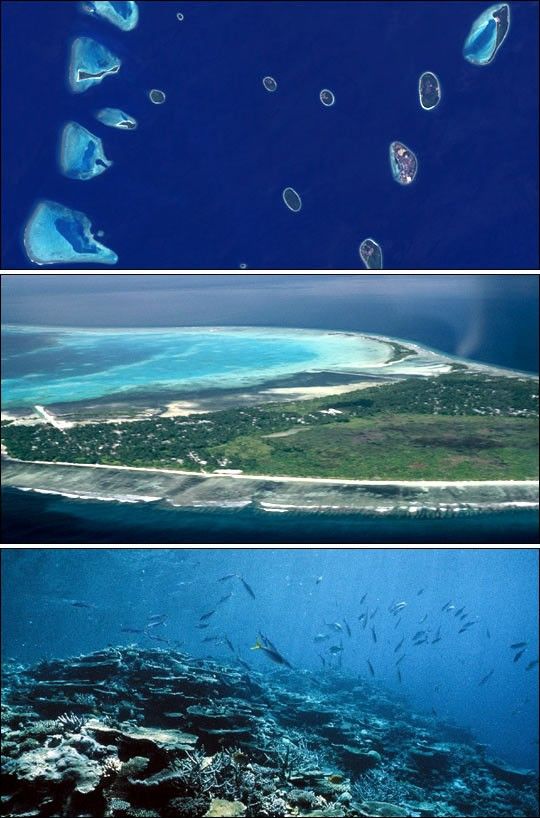
What immediately comes to mind when many of us think of an atoll is adesolate, circular array of coral reefs with white, sandy islandspopulated by a few lonely, swaying palm trees and perhaps a castaway ortwo. Were we to consider them more closely, however, we would find thatthis standard perception just skims the surface. Atolls are, in fact,some of the most complex and vibrant structures on the planet. Builtdiligently over thousands of years by tiny, sea anenome-like coralpolyps, these ring shaped coral structures can be tens of kilometers indiameter with individual reefs large enough to support lush tropicalislands and even small cities. As is the case with any living coralstructure, countless species of fish and invertebrates can be foundinhabiting the waters in and around an atoll. But unlike the fringingreefs along Florida’s coast or even the barrier reefs off the shore ofAustralia, atolls do not border anything. Instead, they sit on a coralbase that often rises thousands of meters from the ocean’s floor in someof the most remote areas of the tropical oceans.
The top picture is a true-color image from the Enhanced ThematicMapper Plus (ETM+) aboard Landsat 7. The middle photograph shows a reef and the flat,forested interior of an island in the Maldives. The bottom photograph demonstratesthe diversity of life in and around coral reefs.
For more information, read AmazingAtolls of the Maldives.
References & Resources
Image and Photographs courtesy Bruce Hatcher and Abdulla Naseer, Dalhousie University