
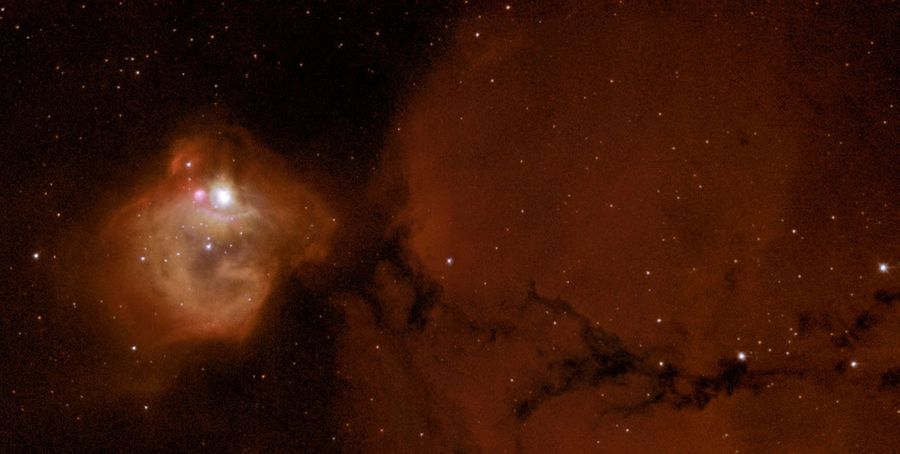
Extremely intense radiation from newly born, ultra-bright stars has blown a glowing spherical bubble in the nebula N83B, also known as NGC 1748. A new NASA Hubble Space Telescope image has helped to decipher the complex interplay of gas and radiation of a star-forming region in...
NASA, ESA, and Mohammad Heydari-Malayeri (Observatoire de Paris, France)
Extremely intense radiation from newly born, ultra-bright stars has blown a glowing spherical bubble in the nebula N83B, also known as NGC 1748. A new Hubble telescope image has helped to decipher the complex interplay of gas and radiation of a star-forming region in the nearby galaxy, the Large Magellanic Cloud. The image graphically illustrates just how these massive stars sculpt their environment by generating powerful winds that alter the shape of the parent gaseous nebula. These processes are also seen in our Milky Way in regions like the Orion Nebula.